What happens when journalists step away from daily deadlines to rethink their craft? As the Reuters Institute Journalist Fellowship Programme accepts applications for 2026-2027, we spoke with former fellow Niko Efstathiou about what time, distance and global exchange can give back to journalism.
Featured image: Courtesy of Reuters Institute
Journalism conferences worth bookmarking in 2026
From learning new tools to questioning power and purpose, this calendar maps the global events shaping journalism in 2026.
There is a moment in many journalism careers that doesn’t come with drama or burnout. It arrives quietly.
You’re still producing. Still publishing. Still chasing stories. But somewhere between deadlines, platform changes and newsroom restructures, the bigger questions start to fade: Why am I doing this? What kind of journalist do I want to be next?
For some journalists, that question leads them to apply for the Reuters Institute Journalist Fellowship Programme, hosted by the Reuters Institute for the Study of Journalism at the University of Oxford. For the academic year 2026-2027, there is an open call running until February 13.
The program offers something increasingly rare in journalism: time.
Not time off, but time to think.
Time to step back, not out
The fellowship brings together 30 mid-career journalists from across the world for a period of research, reflection, and conversation. Fellows step away from daily production to spend three or six months at Oxford, working on a self-directed research project. Their topics often reflect the structural challenges journalism is grappling with today: trust, sustainability, misinformation, audience relationships, technology.
To bring the experience to life, we spoke with Niko Efstathiou, a journalist and author who leads the WIRED Greece (a new arrival to the local media market which is to be launched soon) and was a Reuters Institute Fellow in 2024-2025.
“I was looking for a way to step out of the very fast rhythms of the newsroom, and think critically about what we do, where we fail, and how we can do better,” he explains.
For Efstathiou, the fellowship was ultimately about gaining perspective.
Journalists tend to be very defensive about journalism, and sometimes that prevents us from recognizing our blind spots. I wanted the distance to see the structural problems more clearly.
Niko Efstathiou, editor-in-chief of WIRED Greece, and former fellow
A slower, human pace
What surprised him most upon arriving in Oxford —apart from the prestige— was the “human pace” as he describes it.
“I arrived with notes, plans, outlines,” he recalls. “And the fellowship director told me: ‘Put all of that aside. For the first two weeks, your homework is to walk around the city and think’.”
For someone used to constant output, the instruction felt almost radical.
“No one in our profession tells you to take two weeks just to think,” he explains.
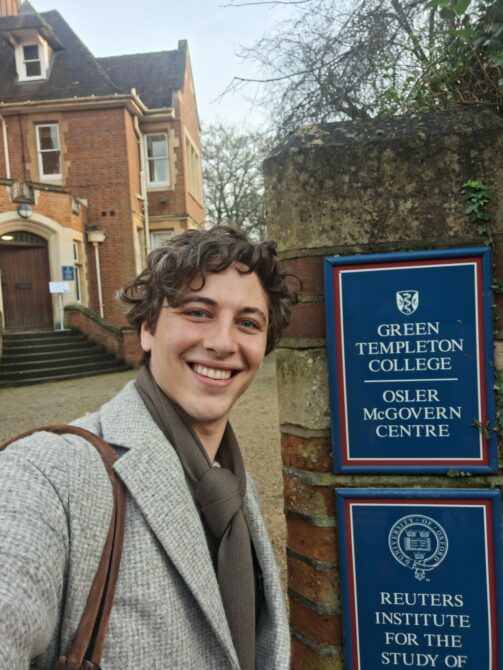
Alongside that time, fellows have access to seminars and discussions with distinguished journalists, editors, industry leaders and academics from around the world. The programme is designed not just as a learning opportunity but as a space where the questions and solutions that matter most to journalism are driven by journalists themselves. As Mitali Mukherjee, Director of the Reuters Institute for the Study of Journalism, noted in a recent interview on why journalists should apply to the fellowships, “the answer to the industry’s problems will come from within journalists” — a perception that runs throughout the program.
I arrived with notes, plans, outlines, and the fellowship director told me: ‘Put all of that aside. For the first two weeks, your homework is to walk around the city and think’.
Niko Efstathiou, editor-in-chief of WIRED Greece, and former fellow
Learning journalism through other realities
Fellows live and work alongside journalists from different media environments: public broadcasters, investigative outlets, local newsrooms, digital start-ups.
One of the defining moments for Niko Efstathiou was a seminar with Lewis Denison, a young political editor for ITV News who had built one of the UK’s most successful vertical video news products on TikTok.
“He didn’t look or sound like the traditional political correspondent, and yet he was reaching millions, asking tough questions, and doing high-quality journalism. It forced me to rethink how we position journalism in relation to content creation.”
Another pivotal moment came from Jazmín Acuña, a fellow from Paraguay, who presented El Surti, a social-first, impact-driven media outlet she had co-founded. The outlet measures success not in clicks, but in real-world outcomes — including policy change.
“That was a moment of optimism,” Efstathiou says. “It showed that journalism can be impact-driven, sustainable, and rigorous at the same time. It’s not theoretical, it’s already happening.”
A publicly available training on investigating AI without fear

Pulitzer Center launched a publicly available online AI program helping journalists understand technological evolution around AI.
Local research, global relevance
During his fellowship, Efstathiou focused his research on wildfires and misinformation, examining how conspiracy theories and information gaps emerge during extreme climate events, and how journalism can respond more effectively.
The project was rooted in Greece, drawing on the 2023 Dadia wildfires, and expanded to case studies in the United States (Los Angeles, 2025), Turkey (Marmaris, 2021) and Chile (Valparaíso, 2024).
“I realized that wildfires are uniquely vulnerable to misinformation,” he explains, “and that newsrooms are often unprepared. We keep reinventing the wheel instead of having a playbook.”
One of the key outcomes of his research was the development of practical pathways for newsrooms, with a focus on preparedness, tone, visual storytelling, the use of satellite data, and local knowledge — all designed to counter misinformation in real time, where it actually spreads. This also included rethinking how fact-checking is communicated.
“Too often, fact-checking is written for people who already trust us,” Efstathiou notes. “But if we want to counter conspiracy theories, we need to speak to the audiences who are actually susceptible to them — not ridicule them.”
One of the most striking case studies was Valparaíso, Chile: early claims that firefighters themselves had started the fires were initially dismissed as conspiracy theories — only to later prove true.
I went in tired, I came back believing again that journalism matters — and that if we give it the value it needs right now, it won’t just survive. It can actually thrive.
Niko Efstathiou, editor-in-chief of WIRED Greece, and former fellow
The added value of the fellowship for news outlets
Efstathiou also stresses the value of the fellowship for news organizations themselves.
“Editors should encourage their journalists to apply,” he says. “The value that comes back is multiplied.”
For him personally, the return from Oxford coincided with the opportunity to build WIRED Greece from the ground up.
As he explains, the fellowship equipped him with strategic thinking, a global network of peers, and practical tools — from AI integration and OSINT methodologies to cutting-edge fact-checking practices.
“Without this experience, I wouldn’t have been ready,” he admits. “Now I feel fully prepared for this new challenge.”
Above all, he returned with something harder to measure: optimism.
“I went in tired,” Efstathiou says. “I came back believing again that journalism matters — and that if we give it the value it needs right now, it won’t just survive. It can actually thrive.”
Thinking of applying?
Applications for the Reuters Institute Journalist Fellowship Programme 2026–2027 close on 13 February 2026.
To apply, candidates need to prepare:
- A one-page project proposal outlining the issue they want to explore
- A one-page motivation statement explaining why this moment matters
- A two-page CV with links to published work
- Two professional references
Fellowships last three or six months and begin in October, January or April.
The Reuters Institute Fellowship is fully funded for most participants, covering programme fees, travel and living costs. Fellows receive a monthly stipend of £2,000 and are expected to refrain from professional work during the program.
You can explore more projects by former Journalist Fellows here.
Curious to learn more? Join the Zoom webinar on Thursday, 29 January, to discover everything you need to know about the programme.