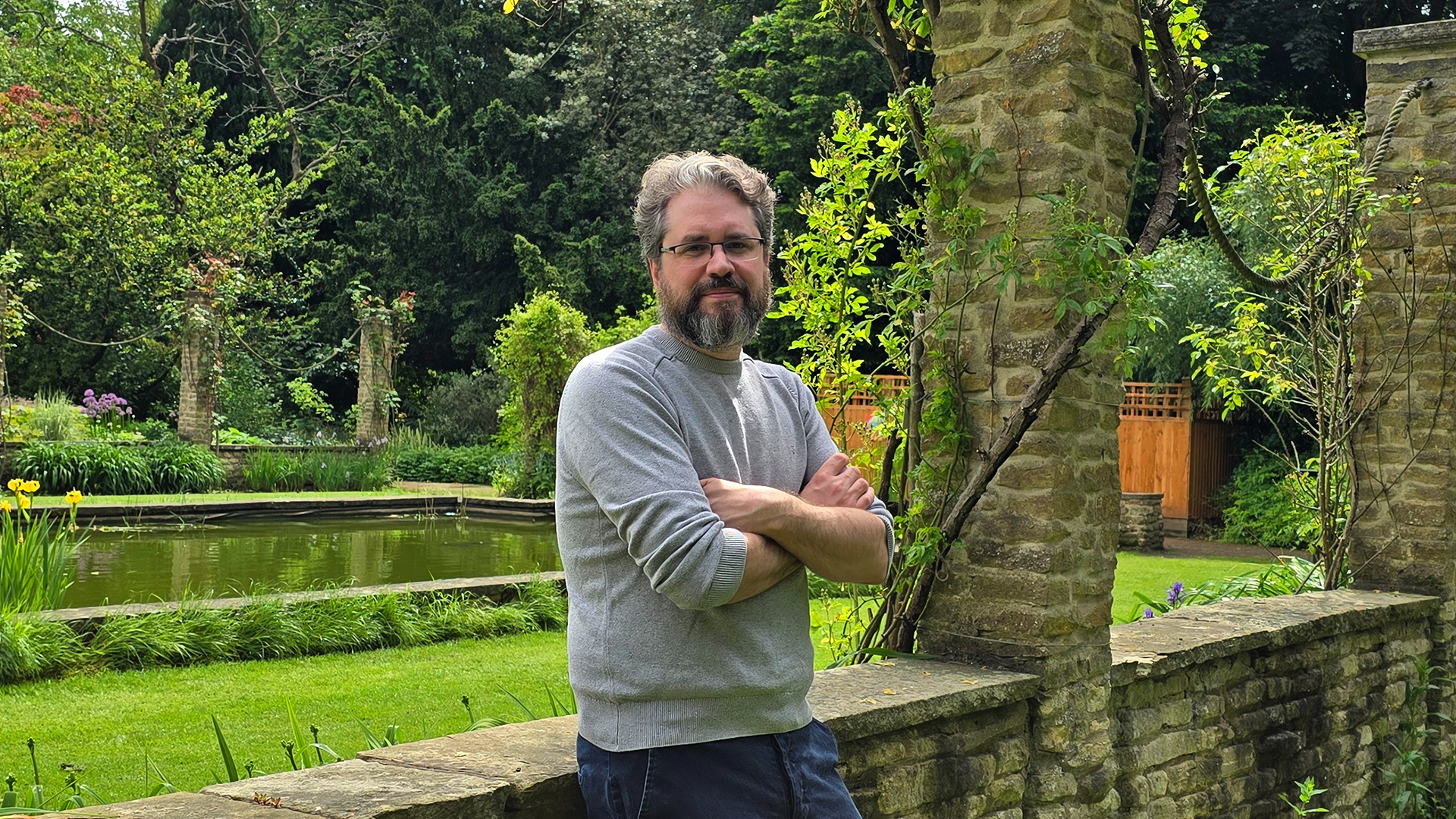
The founder of the investigative platform Bellingcat speaks to iMEdD about algorithms and democracy in the 21st century, the world of intelligence services, and the funding challenges facing investigative journalism.
Featured image: Courtesy of Eliot Higgins
He is constantly accused of being part of the CIA, while Moscow sees him as a tool of Western intelligence agencies. It all began in 2010, when he started researching the events of the Arab Spring online. With no prior experience in journalism and coming from a business management background, he created his own blog. There, using material he found on social media, he published investigations on topics often overlooked by professional journalists covering the events.
Eliot Higgins was a pioneer in open-source investigation, using publicly available information that anyone can access online. In 2014, he founded the investigative platform Bellingcat, a collective of “digital detectives” that has worked on cases such as the downing of flight MH17, the use of chemical weapons by the Assad regime in Syria, and the poisoning of the Skripals and Alexei Navalny with the Russian-made neurotoxin Novichok.
Higgins believes that the work they do helps to put pressure on institutions and “democratize” information. He is particularly concerned about the future of investigative journalism and thinks the world is entering a dark period. “In the past, we have been attacked mainly by three countries: Assad’s Syria, Putin’s Russia, and Orbán’s Hungary. Now, [the list] is being joined by Trump’s America,” he told iMEdD.
You have described Bellingcat as an “intelligence agency for the people.” What do you mean by that?
Τhe access that we have to information coming directly from the ground is incredible compared to what we had 20 or 25 years ago as members of the public. You’d have to be embedded on the ground somehow –as a journalist or some form of agent working for an intelligence agency. Now, you’ve just got people filming stuff on the ground and uploading it online. It’s the same as satellite imagery: Forty years ago, you wouldn’t imagine being able to access it; now everyone has access to satellite imagery […] That ability to gather what you might call “intelligence” has been democratized in a way that’s completely different.
The information systems that we’ve based our democracies around have changed dramatically over the last 20 years. The 20th century model was very much top down, institutional, controlled and gatekept. And now we have access to a lot more information, and it’s more through peer-to-peer, many-to-many networks, which changes the nature of how you can actually interact with it and distribute that information. I think Bellingcat and open-source investigation emerged almost organically from those changes, and I just happened to be in the right place at the right time doing the right thing.
The information systems that we’ve based our democracies around have changed dramatically over the last 20 years. Bellingcat and open-source investigation emerged almost organically from those changes.
Eliot Higgins, Founder and Creative Director, Bellingcat
Jelani Cobb on freedom of speech, the Press, and White House reporting

Jelani Cobb, Dean of the Columbia Journalism School, author, and longtime staff writer for The New Yorker, speaks to iMEdD about academic freedom in the United States, the challenges facing the press today, so-called “Trump coverage,” and the public interest as journalism’s enduring mission.
How does this type of investigation connect to traditional, on-the-ground reporting or reporting done with closed sources? Can open-source investigations exist without traditional reporting?
In any given topic, there can be a kind of range of involvement with both. Part of the reason open-source investigation was so powerful is because you didn’t have journalists who could make it to the ground. It was really the only option. But now we do investigations where journalists can make it to the ground; rather than it being a kind of competition between the two, it’s [more about looking at] the opportunities for them to work together. For example, when we did the MH17 investigation, when we started publishing the route of the missile launcher, journalists on the ground went to those locations and were able to interview local people. They gave them witness statements that not only confirmed what we were saying but also provided more specifics and details that weren’t available in that open-source imagery. This added to our understanding of what was happening. If there is an opportunity to work in a traditional way with open-source journalism, that’s a good thing. It doesn’t take one away from the other.
You’ve said before that open-source investigation was born out of major technological developments of the past two decades. Today, we’ve moved from this idea that social media can democratize information to what some people call the “platform oligarchy”. Do you agree with that?
Actually, I’m doing a lot of work looking at why there are so many people who believe things we know or think aren’t true. The algorithms of social media have played a major role in this, because the problem with algorithms is they’re designed to keep people engaged on platforms, and what people engage with is usually emotionally engaging content. The problem is that’s not generally truthful content in many cases. And even if it is truthful, that’s almost incidental to the fact that it’s engaging. So, what we end up with is that people are being served content that reinforces what they already believe and engages with them very rapidly on an emotional level as they’re scrolling through. That actually shapes the behavior of people who are creating content for these websites as well. Because if you want to be successful online, you have to know how to create engaging content, which means it’s emotionally engaging, not truthful. So, what you end up with is people kind of splintering into different realities, effectively different bubbles. […]
I have this model of democracy, where I say that verification, deliberation, and accountability are the three core functions of democracy. Without those, you start having a democracy that regresses towards authoritarianism or collapse.
Eliot Higgins, Founder and Creative Director, Bellingcat
I have this model of democracy, where I say that verification, deliberation, and accountability are the three core functions of democracy. And without those, you start having a democracy that regresses towards authoritarianism or collapse. And those three functions were really done by institutions. In the 20th century newspapers had that verification process where you expected to read stuff that was true. Obviously that was imperfect in many countries and still is today, but we as a public had trust in institutions for that to be delivered with us. […] The problem now is that verification doesn’t happen solely in those institutions anymore. It happens to us because we’re now the recipients and the distributors of information. So, when you’re scrolling through your feed and you retweet something, you are not really verifying it, but you are distributing it. So, the verification function that is essential for a healthy democracy just collapses. In terms of deliberation, that was also being done by parliaments and other institutions. I’m sure the public debate and vote, but really that was held in those institutions. But now that’s happening in public online spaces, where there’s no room for real deliberation, because it’s always on to the next thing. That’s kind of why Trump was so successful: he had one crisis or event after another, but you could never get your feet on the ground. In the old system, you had the morning paper, you watched the evening news, there was a parliamentary debate. A topic could be debated and [undergo] deliberation.
We’re now the recipients and the distributors of information. When you’re scrolling through your feed and you retweet something, you are not really verifying it, but you are distributing it. So, the verification function that is essential for a healthy democracy just collapses.
Eliot Higgins, Founder and Creative Director, Bellingcat
Now that has collapsed flat again. The accountability part relies on verification and deliberation. [Without these,] a healthy democracy can’t really function. So, those who want to get away with stuff can get away with that. And Trump is a perfect example of that –there’s no real accountability for him because it’s always on to the next thing, and we’re never really sure what’s going on. And for me, what that’s actually leading to is almost a default state that democracies slide towards, or this more authoritarian form of democracy, like we’re seeing in the US. […] So, yeah, algorithms and social media are an issue, but it’s not just a matter of saying “algorithms are bad”. I think we have to understand it in terms of a collapse of how we come to a shared understanding of the world. Rather than having a shared pseudo environment, we all have our own pseudo environment surrounded by people who agree with us. And that splintering means that it’s very easy for people to think that people outside of that are fools, idiots, or betrayers. And that sets us against each other.

Photography for the King’s College. Courtesy of Eliot Higgins.
Can you briefly walk us through how you worked on the investigation into the poisoning of Alexei Navalny?
We used open-source techniques, but it went beyond that because that actually was really part of a string of investigations that started with the Skripal poisoning in Salisbury. That’s where my colleague Christo Grozev first came up with the idea that you could use this Probiv, the Russian data black market, to buy data. So, Christo bought the passport registration forms for the two Skripal suspects based off passport numbers from flight logs coming into the UK. The numbers were a few apart, which is why they were suspicious.
We thought it’s not going to be so easy –that it would come back with Secret Service stamped on the thing and the phone number of the Russian Ministry of Defense. But that’s literally what was on there. We were shocked at how obvious it was. Then, using leaked databases, government databases of house registrations, car registrations, and just loads of different datasets, it was possible to piece together their false identity, and also the pattern used with their real identity that [ultimately revealed they belonged to] the GRU. This also led to phone records where there was a Russian scientist who had been called up multiple times before the poisoning and other poisonings these guys were linked to. So, when Navalny was poisoned, Christo purchased the phone records of this scientist, which, incredibly, weren’t protected in any way. You could just buy them from this Probiv market. And again there, just before the poisoning, he started getting lots of phone calls from Russian FSB officers. Now, just as an aside, finding out these were FSB officers in some cases was really easy, because in Russia you have these phone book apps where you can put in a number and it gives you the [name associated with it]; if you get a phone number you can type in the name of someone and it’ll upload it to a central server, but that’s shared by everyone. So, if you meet someone from the FSB and [save them as, say,] “Igor FSB” into your phone, then you can actually look that number up, and it’ll be there with all the different versions of this thing. So, we figured out very quickly he was talking to these FSB guys, and the phone records of those guys also have all their phone metadata of where they were and where they were travelling.
We wouldn’t do an investigation like that anymore, because it is so not open-source. But it ended up obviously revealing this huge story –it wasn’t just about Navalny or the Skripals, it was multiple poisonings of people like Vladimir Kara-Murza, or Dmitry Bykov, the poet. Other opposition figures in Russia had also been targeted by these poisoning teams of the FSB or the GRU when they were operating abroad. So, it showed that this wasn’t a one-off. This was a state campaign of poisoning using nerve agents that were being produced illegally by Russia in violation of various treaties.
It’s not just a matter of saying ‘algorithms are bad’. We have to understand it in terms of a collapse of how we come to a shared understanding of the world. Rather than having a shared pseudo environment, we all have our own pseudo environment surrounded by people who agree with us.
Eliot Higgins, Founder and Creative Director, Bellingcat
I read in Foreign Policy that former CIA officials say they love Bellingcat’s work, because it allows them to give your findings directly to Russian diplomats as facts without putting their own sources at risk. How does that make you feel?
I’ve heard that a lot. In a way it’s both good and bad. Believe me, it’s now being used to say that Bellingcat is the CIA. It’s the definitive proof that we needed to prove it. So, that’s annoying. At the same time the fact that they can say that “yeah, this stuff’s super reliable” and it comes from someone so senior in the world of intelligence, I think, shows how reliable the information is. But we don’t publish it thinking, “oh, the CIA can use this” or “these people can use this”. It’s just information that’s true, that’s out there. I know people who’ve worked at places like the UN and other big international institutions where they say, “what’s great about your work is we can just say we know you’re lying and here’s the analysis of you lying. This isn’t just you versus me. This is you versus reality.” And that’s helped people a lot. […]
We write on a whole range of different topics. We’re writing about Israel and the US at the moment, because there is a lot of very bad stuff happening there. We’re often accused of only writing about Russia, which is annoying because that’s not the case. But for me, it’s not only about what we publish on the website, it’s about saying we can do this. But you can do this stuff as well. I’m teaching people how to do this by themselves.
There is a lot of talk in the journalism world about funding. I have heard it being called “the elephant in the room.” Some people argue that many investigative outlets, either openly or secretly, are being funded by Western governments or even the CIA or other intelligence agencies. What is your opinion on that?
This is something that we’re accused of a lot because we used to take money from the National Endowment for Democracy, and there is a subset of people who think that they are effectively the CIA in all but name. And therefore, in their view, Bellingcat is working for the CIA, which is complete nonsense. Τhat money from the National Endowment for Democracy was for us to train journalists to do open-source investigations for one thing.
Αnd also, I think people look for excuses to ignore evidence and information. So, it’s a useful one to say “oh, well, they’re all working for the CIA”, because then you don’t have to think or engage with the information. That’s not to say that intelligence agencies don’t, you know, maybe pay some journalists or influence them in some way. But I think with Bellingcat we’ve done as much as we can to keep that editorial independence and be transparent. […]

It’s really hard to be a sustainable journalism organization if you’re doing investigative journalism —especially in a media environment driven by engagement, because investigative journalism is rarely engagement worthy.
Eliot Higgins, Founder and Creative Director, Bellingcat
I think in terms of funding, it’s tricky. You’re probably [aware of the] USA funding cuts in the journalism NGO sector. It’s been absolutely devastating for a lot of journalism NGOs, because they really relied on that money. But in a way, it’s a problem that they have to rely on that money to be a sustainable journalism organization. And that’s not saying they should have done better to be sustainable, but it’s really hard to be a sustainable journalism organization if you’re doing investigative journalism —especially in a media environment driven by engagement, because investigative journalism is rarely engagement worthy. We struggle with this a lot. How do we engage our journalism with audiences in this new environment? And if you want to make money as an investigative journalism organization, being able to do that through advertising, I think is next to impossible.
So, you then rely on the whole funder community. Now there’s different types of funders. We take money from, you know, postcode lotteries, and family foundations. We no longer take money from governments or organizations fully or significantly funded by governments. We crowdfund, we raise our own money through workshops, and we’re lucky in a way that we can have a diverse range of funding for Bellingcat. But other NGOs, especially in the Global South, have far fewer options, so they become much more reliant on things like USAID, which are government-funded. But then that opens them up to attacks from people who want to dismiss their work. They’re saying, oh, you’re just doing what the US government is saying to you. So, I’d also say there’s a bit of a slippery slope in terms of opening yourself up to attacks by taking the money, but also, at the same time, being able to do journalism that has impact […].
This interview is edited for length and clarity.