Reflections on the relationship between journalism and documentary, one that is neither simple nor coincidental. On the contrary, tools and perspectives are constantly transferred from one field to another.
Translation: Evita Lykou
Featured image: Konstantinos Melitas
Turning points, censorship and technological change: Dust from the ’50s
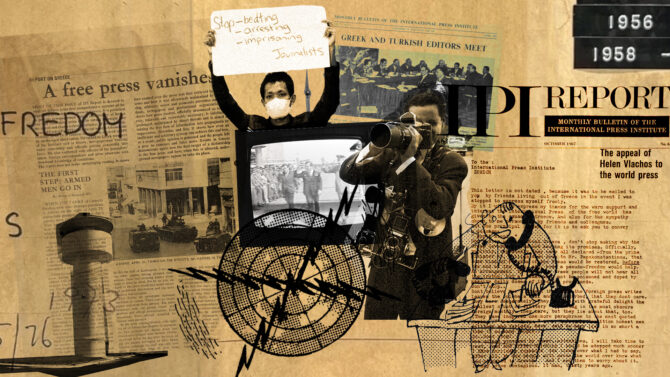
A digital exhibition by the International Press Institute brings to light just a small sample from a true archival goldmine. We spoke with members of the IPI team about the major undertaking of organizing and opening up an archive that chronicles the history of press freedom around the world.
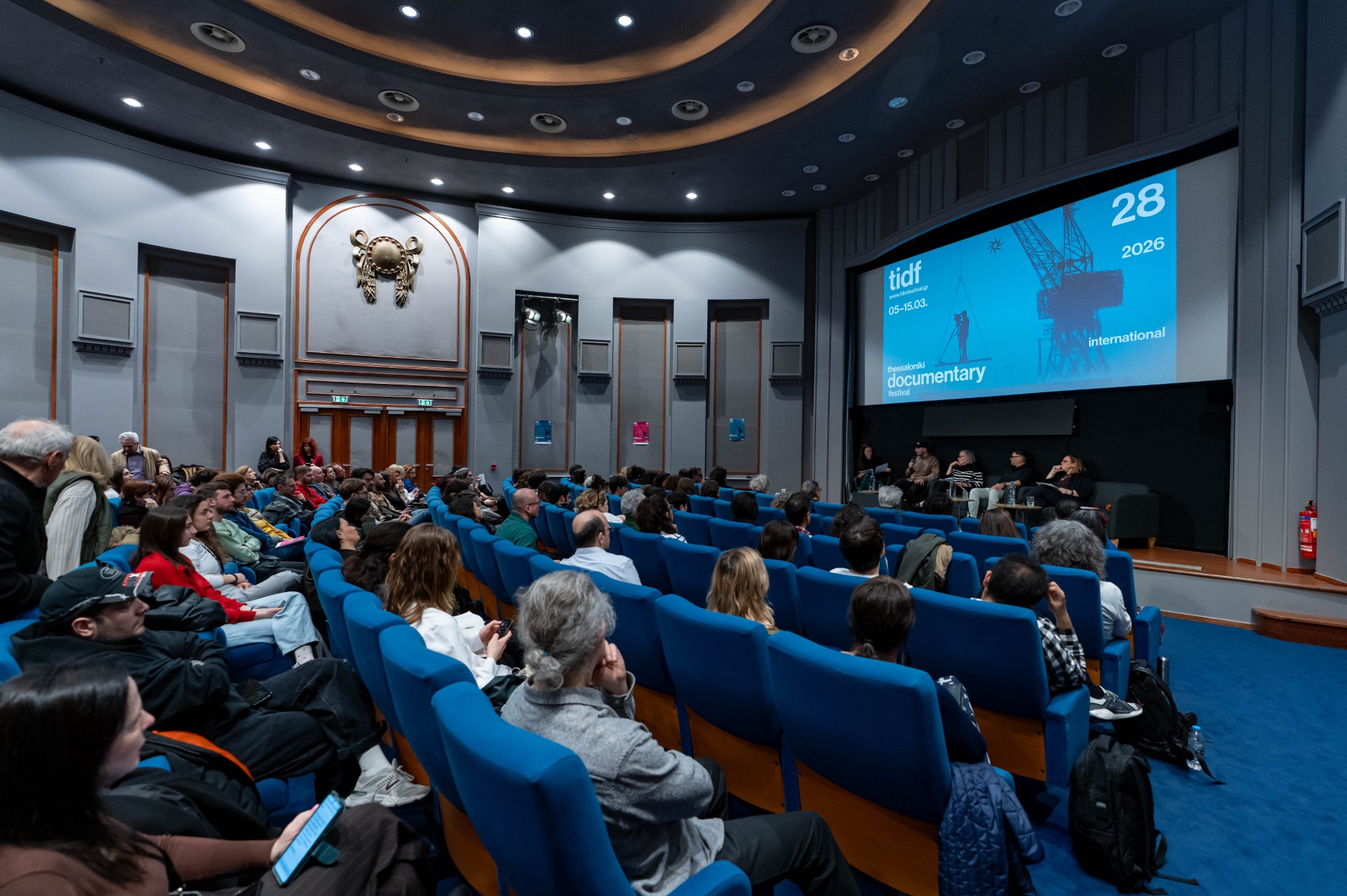
While sitting in the dark auditoriums of the Festival, I was reminded once again that the relationship between journalism and documentary is neither simple nor coincidental. It’s becoming increasingly clear that tools and perspectives are constantly transferred from one field to another, changing form but not substance. This year’s Festival program included documentaries that began as pure journalistic projects and films based on years of research prior to production.
Notably, three films that began as journalistic projects under the second cycle of the iMEdD Incubator in 2020 were included in this year’s program and received awards at the 28th Thessaloniki Documentary Festival. Marianna Economou’s Where Shadows Rest was first conceptualized at the Incubator as a research project on abandoned shipwrecks and their socio-environmental implications in Elefsina (under the title Shipwrecked). It turned out to be an atmospheric observational documentary and was awarded Best Greek Film by the Youth Jury. EXILE(S), Tales From an Island by Yorgos Iliopoulos, began as a journalistic exploration of the experience of exile and identity on an island of the Aegean; evolved into a portrait of memory; and won the ERT Award, the FIPRESCI Award for Best Greek Documentary and a Special Mention for “Human Rights in Motion” Award. Similarly, Irini Vourloumi’s The Way Elsewhere, which began as an observational project about Athens through the eyes of three taxi drivers (initially titled The Secrets of the Owl), premiered in the international competition section. The film offered a glimpse of the city and gained a distinctive presence in the festival market, receiving positive reviews.
As a journalist, I first considered the narrative style. A good documentary is rarely told in a straightforward way. Rather, it creates a rhythm, allows the characters to develop, revisits scenes and emphasizes the atmosphere of a place. While reporting is often limited to headlines and statements under the pressure of everyday life, documentaries ask viewers to stay with the story and communicate with the protagonists, trying to experience their reality. If we want the public to understand the complexity of an issue, we can’t rely on bullet points alone. It takes context, a course and time.
A second thought concerns the visual language. In a documentary, the director cannot hide behind a synopsis. They need to show, not “tell”. A movement, a dark corridor or a glance can convey information and emotion. This is a major challenge for audiovisual formats, from TV news reports and short documentaries to explainers and social media videos –less narration over the image, more scenes, characters and details that enhance the documentation.
The three documentaries supported by iMEdD and many others that I have had the opportunity to watch (such as Around Paradise, We Are Stardust, Survivors – Reclaiming Her Myth, and The Culprits) were all based on long-term trust-building with individuals and communities. The creators returned repeatedly to the same place and space; meeting the same people of interest; and listening to, and recording stories and narratives. This different relationship with time made me realize how often we forget the value of “slow journalism” and research in journalism.
We live in an age of speed where the media ecosystem increasingly pushes for “hot” opinions and quick answers. On the other hand, documentaries seem to resist this logic. They are not afraid of prolonged silence.
We live in a “crazy” age of speed where the media ecosystem increasingly pushes for “hot” opinions and quick answers. On the other hand, documentaries seem to resist this logic. They are not afraid of prolonged silence or what it implies. They recognize that their role is not necessarily to end the conversation but to expand it. This is a useful reminder for journalists: admitting the complexity of a subject is not a sign of weakness, especially when you have thoroughly documented it.
On the other hand, the documentary genre has a lot to gain from journalism. Journalistic work is supported by tools that facilitate research, documentation, fact-checking, source verification, data management and information access. Nowadays, the concept of reality itself is constantly being questioned. Oftentimes, we don’t know if what we see is real. These tools can act as a shield, as a line of defense to protect the truth. A documentary can evoke emotion, captivate and impress, but it must also be able to answer questions about errors or omissions.
Local journalism, with love — and as an antidote to alienation
If the ambition is real systemic change, then backing locally embedded, community-rooted journalism is not charity. It is common sense.
Despite its flaws, journalism has established codes of conduct related to fair representation, the right of correction and transparency with the public. Documentaries dealing with social and sensitive issues must, in their own way, be able to answer a series of questions –from who is at risk and why are we showing these people, to who speaks and who remains silent. This culture of journalistic accountability can serve as an important guide for documentary filmmakers, ensuring that the effort to showcase a strong scene does not interfere with accountability to the subjects and audience.
This culture of journalistic accountability can serve as an important guide for documentary filmmakers, ensuring the effort to showcase a strong scene does not interfere with accountability to subjects and audience.
During the week of the Festival, I heard the word “impact” more than a few times in various conversations. Nowadays, many filmmakers don’t end the conversation on what story we tell, but carry it on to what we want the story we tell to change. This approach is familiar to journalists: who is the story about? Who else will it affect? Does it open up a wider debate? What political, social or economic consequences might it have? If adopted, this logic could be useful for documentaries, too. It could open up a broader discussion about planning screening strategies and collaborating with organizations or local communities.
Journalism takes many forms, including classic articles, podcasts, explainers and data visualizations. Documentary filmmakers can extend their projects’ lifespans by adopting and using such practices, which could allow them to reach audiences beyond cinema screenings.
In a world of fragmented attention spans, the combination of journalism and documentary is more than just an aesthetic choice. It can also be part of a broader survival strategy.