Irene Caselli, a multimedia journalist and writer who co-leads the Early Childhood Journalism Initiative, will be a mentor at the trauma and resilience retreat organized by the Global Center for Journalism and Trauma and iMEdD. Here, she explains what slowing down really means for journalism.
Recognizing and addressing burnout in the newsroom
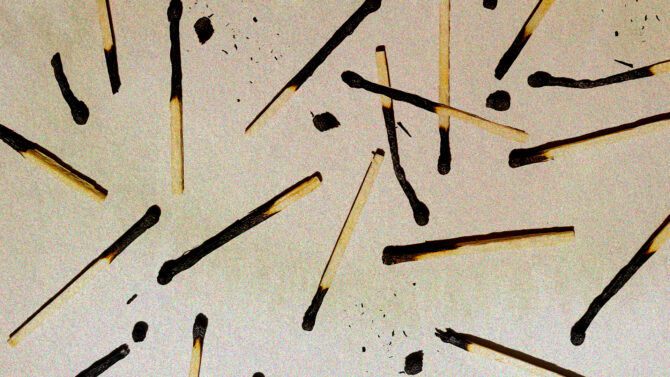
Speaking to iMEdD, experts warn burnout in journalism goes beyond exhaustion and now poses serious risks to press freedom.
I’ve spent most of my adult life as a freelance journalist: over 20 years juggling projects, checking email too often to see if an editor had responded to a pitch, not knowing where my income would come from weeks or months down the road.
I’ve also been able to travel often, get to know people from all different backgrounds around the world, and I’ve mostly managed to be around for my family and friends when needed — the joys of remote working and flexible hours.
But being on call 24/7 — the 1 a.m. calls, the holidays turned into work trips — while also facing uncertainty – took a toll. I felt it particularly when I was a foreign correspondent in Latin America, when breaking news was my bread and butter.
I thought I was broken. I couldn’t take the intensity and unpredictability anymore, and I was afraid I would make a serious mistake. Training by the Dart Center in 2018, the predecessor of the Global Center for Journalism & Trauma, helped me realise that what I was experiencing was not unusual for a journalist who spends years absorbing other people’s stories of trauma and living at an accelerated pace day in and day out. I realised that I had to look after myself in order to keep going.
The knowledge and tools I got from that training gave me the freedom to rethink my career as a journalist. Eventually, I reinvented myself as a journalist focused almost exclusively on children and caregivers. If breaking news was taking me away from journalism, I made space to find new, slower ways of reporting. I also learnt ways to get offline: I turned off alerts on my phone, removed social networks, set times when I would be off my phone, and stopped scrolling.
But what does “offline” actually mean for a journalist? It doesn’t mean ignoring what is happening. It means creating enough distance from the constant bombardment of information to decide what deserves attention.
As the algorithms intensify our addictions and AI-generated misinformation floods our screens, we have a duty to slow down and practice our discernment. It is counterintuitive. If you’ve always been used to reacting fast, pausing can seem almost nonsensical. But it is vital to us as individuals and as journalists, and to the kind of journalism we want to do. This is what I hope my peers will take away from this retreat: slowing down and looking after ourselves aren’t separate from the work. They change the way we do the work.
Irene Caselli will dive deeper into this as a mentor at the trauma and resilience retreat to be held in October 2026 in Vamvakou, Laconia, Greece, by the Global Center for Journalism & Trauma and iMEdD.