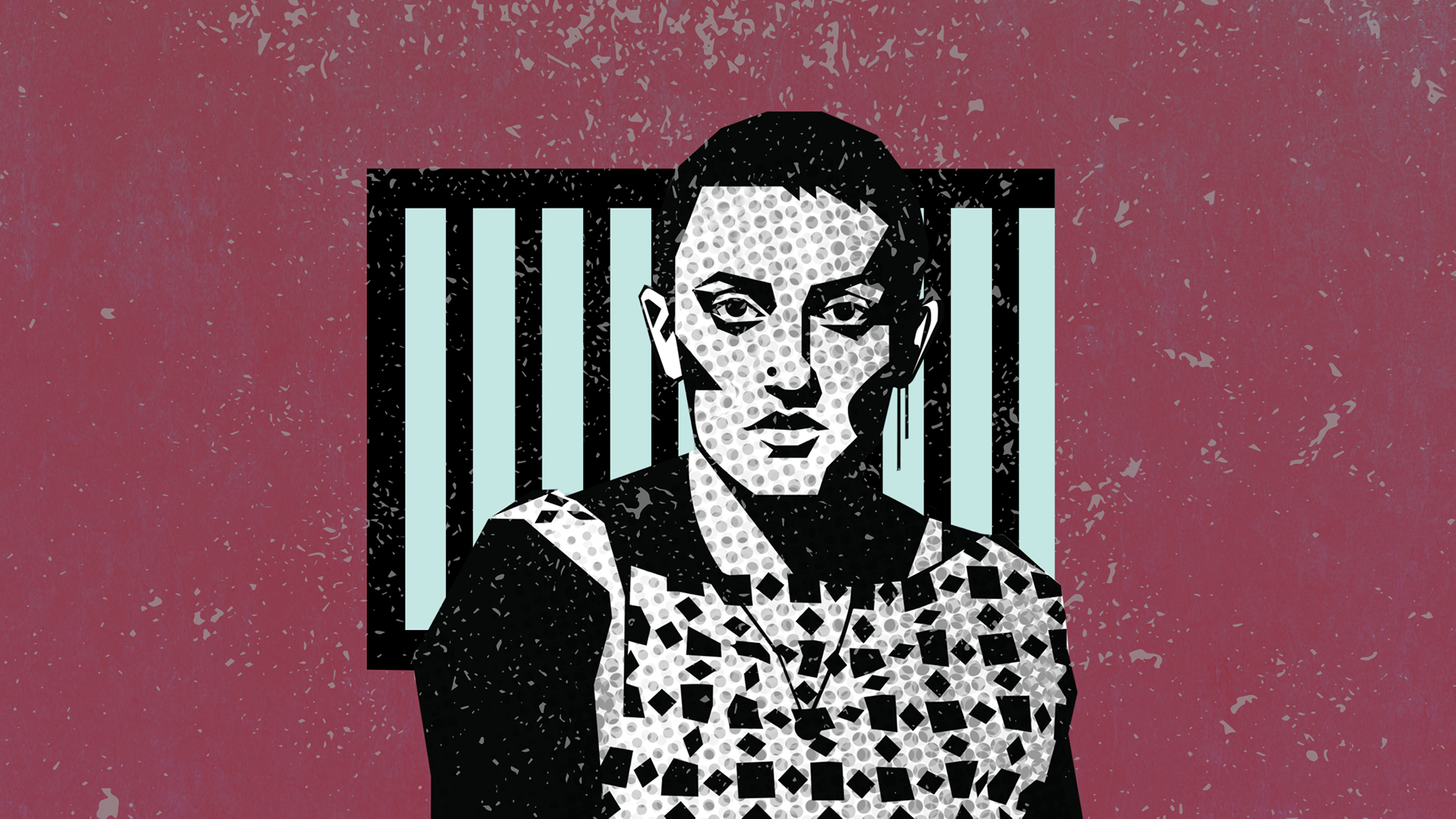
An entire newsroom jailed. A different newsroom shuttered. A sentencing in absentia. A few days ahead of a possible prison sentence, Lina Attalah, the embattled editor-in-chief of Egypt’s Mada Masr, and other journalists discuss the “suffocation” of independent media in Egypt.
Featured image: Illustration by Evgenios Kalofolias / Photo: Jennifer 8. Lee, Wikimedia, WikiPortraits at 2024 International Journalism Festival, CC BY-SA 4.0
Lina Attalah had a bad feeling about the summons she’d just received. It wouldn’t be the first or even the third time the co-founder and editor-in-chief of Mada Masr (roughly, Arabic for “Scope of Egypt”), arguably the most prominent of the handful of independent news outlets based in Egypt, would be interrogated by prosecutors. But this time, the 44-year-old Attalah told iMEdD: it felt like “something bigger is in the making.”
The interrogation on October 21, 2026 was one of the longest and most tiring sessions she’d ever been put through. She said they went around in circles, asking repeatedly about her website’s lack of a regulatory license, something Attalah had applied for several times since 2018. “I felt there was something different, even though I was released on bail –and it was a big bail compared to other bails [she’d had to pay in the past]. I felt like this is not going to stop here.”
She was right.
Less than a week later, on October 27, a judge summarily dismissed her legal team’s request for time to review the case, appointed her a new lawyer, convicted her of operating a website without a license (a misdemeanor since 2018), ordered the website to be closed, fined her the maximum penalty of three million Egyptian pounds (around 50,000 euros), and ordered Attalah detained until the fine was paid in full. After several anxious hours in custody, the money was gathered, Attalah was released, and an appeal filed.
But it didn’t stop there. While Attalah was being held in custody, she learned that she had been convicted in absentia in 2024 of the same offense, but with the additional charge of “spreading false news,” and sentenced to a year in prison.
The 27th of October was a terrible day. It was very, very charged. It’s the first time we hear a verdict from a court saying that Mada [Masr] should be closed. Everything felt excessive and intense, including the way I was arrested and taken away forcibly from the courtroom.
Lina Attalah, editor-in-chief, Mada Masr
Neither she nor the Egyptian Journalists Syndicate, of which she is a member, had been notified during those two years even though she was in the country the entire time. A retrial is now pending; it was postponed to allow the court to consider her legal team’s request to dismiss the judge, who happens to be the same one who ordered Mada Masr shuttered and Attalah detained, last month.
“I’m trying not to be broken by it,” Attalah said, smiling ruefully on a video call with iMEdD from her home in Cairo on November 16. At the time of the interview, her retrial hadn’t yet been postponed, and she believed she was facing court and a possible jail sentence in less than 48 hours.
“The 27th of October was a terrible day,” Attalah recalled. “It was very, very charged. It’s the first time we hear a verdict from a court saying that Mada [Masr] should be closed. Everything felt excessive and intense, including the way I was arrested and taken away forcibly from the courtroom. There’s a fine? We’ll pay the fine. I don’t need to be handcuffed and pulled and thrown in a cell in the basement of the courtroom.”
Lobna Darwish, the advocacy director of the Egyptian Initiative for Personal Rights (EIPR) a human rights NGO whose lawyers are part of Attalah’s legal team told iMEdD that in Egypt, procedural irregularities are common in political cases.
“But this is a level that we’ve never seen before,” Darwish said. “Not only not allowing access to the case file – that we’ve seen before. But for the judge to call a random lawyer as her counsel and to speak on behalf of that lawyer in front of everybody, that’s unseen and unheard of.”
“This whole thing is a sham,” said Lina El Wardani, a journalist and friend of Attalah who was at court that day. “That was maybe the quickest trial I’ve seen in my entire life. There was a stranger appointed by the court who just sat there smiling and did nothing. And the judge kept writing. I mean, at least during [deposed ex-president, Hosni] Mubarak, there was some kind of pretending; we pretend[ed] to abide by the law, we pretend[ed] to have a free press. There were some red lines, but then there was room for maneuver. Now there is no room for maneuver.”
How it started
In October, Egypt’s journalism community was already on high alert.
On September 28 and 29, plainclothes officers had entered the homes of four young journalists, located in several cities. Without identifying themselves or showing warrants, the officers detained them and confiscated all the electronic equipment they could find, even those that did not belong to the journalists, Darwish told iMEdD, whose organization is representing them.
Two more journalists were later arrested on the streets of Cairo. The six detainees, the youngest of whom was a 21-year-old intern, made up the entirety of the newsroom of the independent fact-checking website Matsadaash (Arabic for “Don’t believe it”).
For five days, their friends and families had no idea where they were. When they emerged, facing a state prosecutor, they testified to being threatened, beaten, and forced to sign false confessions, said Darwish. Still in pre-trial detention as of this writing, they have been charged with spreading false news and belonging to and financing a terrorist organization. The latter charges can carry the death penalty.
“It’s a very devastating moment,” said Darwish, who confirmed that the six have still, as of this writing, not been allowed to meet in private with their counsel. “We’re seeing people in these situations lose 10 years of their lives, either with prison sentences or renewing pretrial detention for years. They know this because they’re journalists, so they’re quite afraid.”
Support for the detained journalists by dozens of international organizations poured in, and sit-ins were organized at the Syndicate. For Attalah, it was personal.
“I personally mentored and edited and worked with four of them,” said Attalah, who takes pride in her 13-year-old news operation having become a training ground for young journalists.
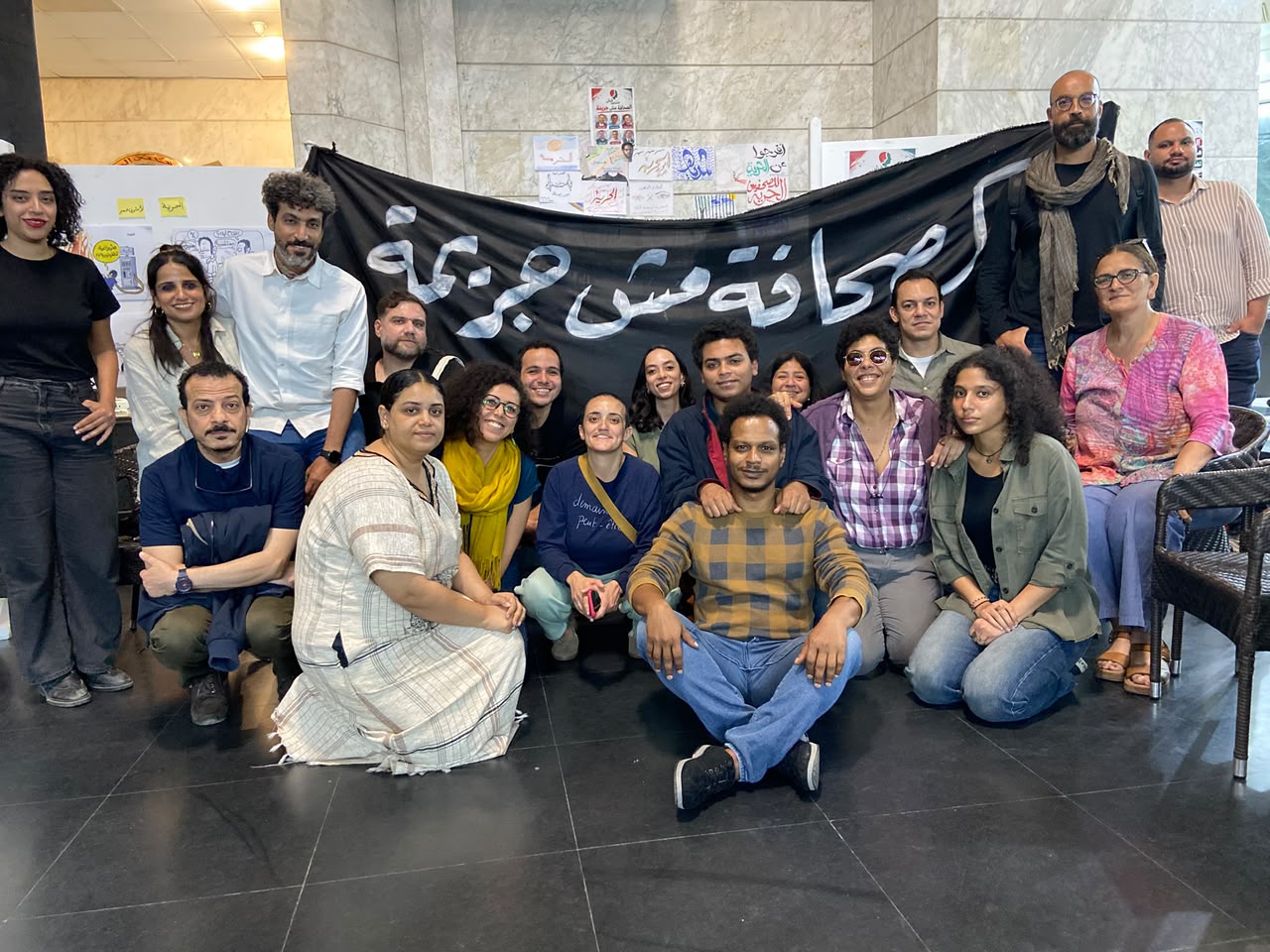
Three days before her interrogation in October 2026, Mada Masr announced it had joined up with seven other independent media outlets, from Egypt, Syria, Tunisia, and Lebanon, to fact-check an upcoming conference organized by the Egyptian government, in solidarity with the jailed Matsadaash journalists. “We were completely enmeshed in the story –until we became the story,” she said.
Strange timing, chilling messaging
Sara Qudah, the regional director for the Middle East and North Africa at the Committee to Protect Journalists (CPJ) told iMEdD that what is happening right now “is a coordinated attack on the independent media scene in Egypt.”
After the arrests, she went back to look over Mada Masr and Matsadaash’s reporting of the past months to try and understand what may have induced the government to shut down two entire newsrooms, but came up short.
“We didn’t see anything alarming or amounting to a place where the government is afraid of them or saw a huge violation,” said Qudah. In fact, as regard to Matsadaash, she added: “They were doing the government a favor when they debunk false information targeting the government. And they also debunk false information coming from the Muslim Brotherhood. They were doing actual debunking.”
Attalah, who was named one of Time magazine’s 100 most influential people of 2020 and received a Knight International Journalism Award that same year, also doesn’t know why the crackdown is happening now.
I’m not here to fight the government. I’m here to serve my people, my society, my communities. We try to ask what it is that’s happening. We try to get some answers […], so that people have what it takes to start talking in an informed way. And I do think that this is a cornerstone of stability.
Lina Attalah, editor-in-chief, Mada Masr
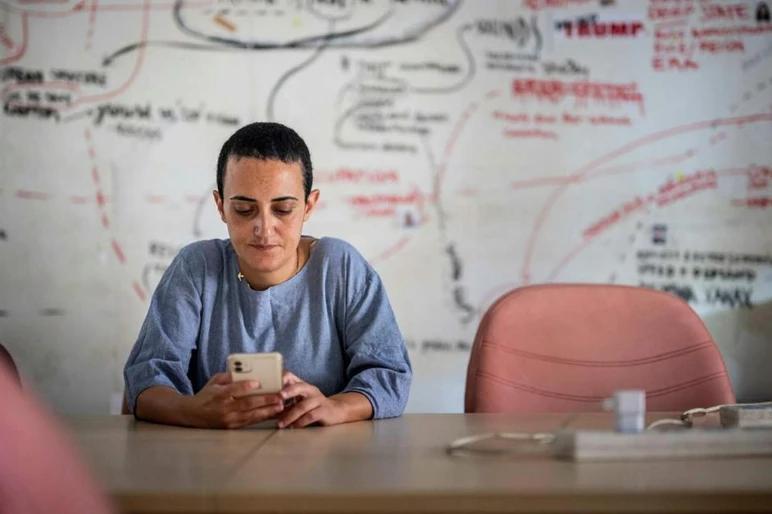
“I’m not here to fight the government,” she said. “I’m here to serve my people, my society, my communities. I feel like they [the government] are making us fight with them all the time. […] The importance of the work we do lies in the fact that we try to ask what it is that’s happening. We try to get some answers. We try to channel these answers to our audiences so that people have what it takes to start thinking and understanding and to start talking about it amongst themselves in an informed way. And I do think that this is a cornerstone of stability.”
Lina El Wardani has worked as a journalist and editor in Egypt since 2002. In a video call, she told iMEdD that there has never been a more dangerous time to be in this profession. “I covered wars in Sudan, Libya, clashes all over the region, and I never really felt in danger. But now I feel in danger. Now I feel that no one is safe […] The attack is on the profession itself.”
Qudah says Attalah’s conviction sends “a very chilling message to all independent journalists in Egypt that they might be attacked at any point. We do not know what to expect. […] I would say that every single person who is following the case is worried.”
If Attalah is sent to prison, she would be joining 25 other journalists behind bars in Egypt, where the longest incarcerated one has been in prison since 2013, according to the CPJ.
Today, the country ranks 169th out of 180 countries in Reporters Without Borders (RSF) World Press Freedom Index, its second-worst showing after 2025, when it was ranked 170th.
It wasn’t destined to be this way.
A dream of spring
Even before the 2011 revolution, which saw the fall of Hosni Mubarak, Egypt’s strongman of nearly 30 years, there had been a blossoming of private media on television and in print starting in the early 2000s.
“Primarily because the regime was trying to liberalize the economy, part of opening up the market and the economy was to also make a space for corporate media,” said Attalah. “And this is the time, for example, when Egypt gets a lot of political TV.”
I covered wars in Sudan, Libya, clashes all over the region, and I never really felt in danger. But now I feel in danger. […] The attack is on the profession itself.
Lina El Wardani, journalist and editor
A few things were off-limits. While working at Al-Ahram, Egypt’s paper of record, El Wardani says her editor told her: “There are three things you cannot touch. Mubarak, his wife and his kids, and the military. Other than those three, knock yourself out. Go write about corruption, go write about violence against women, labor rights.” And she did. Later, she crossed paths with Attalah at the BBC’s Arabic service and freelanced for Al Jazeera.
Then came the revolution.
“And the sky was the limit,” recalled El Wardani, who now works as an editor at Egab. “Oh my goodness, we wrote about everything and anything –I myself wrote about rigging the elections.”
But the freedom was short-lived.
In 2013, after mass protests, Mohamed Morsi, Egypt’s first democratically elected President following decades of military rule, was deposed and arrested in a coup. Mada Masr was born in that uncertain and dangerous time.
“We hit the first publish button on the 30th of June 2013 when the protests began, asking for Morsi to leave,” said Attalah. “It (Mada Masr) became a reality, which was a miracle. It continued to survive, which was a miracle. It grew, which was a miracle.”
While Mada Masr was growing and, against all odds, surviving, Egypt’s current president, Abdel Fattah el-Sisi, took control. And slowly, press freedom began to be curtailed. By 2018, the lively ecosystem of private media outlets had withered.
Legal tools are used in different ways against journalists in Egypt to make sure that the remaining tiny margin of independent journalism in the country is suffocating. Basically, suffocate what’s left.
Lobna Darwish, EIPR Advocacy Director
“Starting in 2013, things begin to shut down one by one,” Attalah said. “The corporate media is either now directly controlled by the authorities through ownership, or just political control through censorship and self-censorship. In this context, there was this small margin – that I would claim that we opened somehow – of projects like Mada [Masr], where we just tried to continue what we were doing even before 2011: accountability, covering corruption, engaging with the political landscape and so on. But, the main difference is that you’re doing this on your own mostly now.”
“Legal tools are used in different ways against journalists in Egypt to make sure that the remaining tiny margin of independent journalism in the country is suffocating,” said Darwish. “Basically, suffocate what’s left.”
Smoke and mirrors
Internet access to Mada Masr has been blocked in Egypt since 2017, but, as senior editor Mohamed Hamama explained to iMEdD, since no legal order has been issued, they are in theory within their rights to use a number of mirroring sites for local readers to reach them.
“It has had huge impact on our readership, because we keep changing mirrors,” said the 40-year-old Hamama, who has worked at Mada Masr since 2015. “It made it almost impossible to track readership… but if we combine everything, the website and the different social medias and the [newsletter] emails, it’s in the millions every month.”
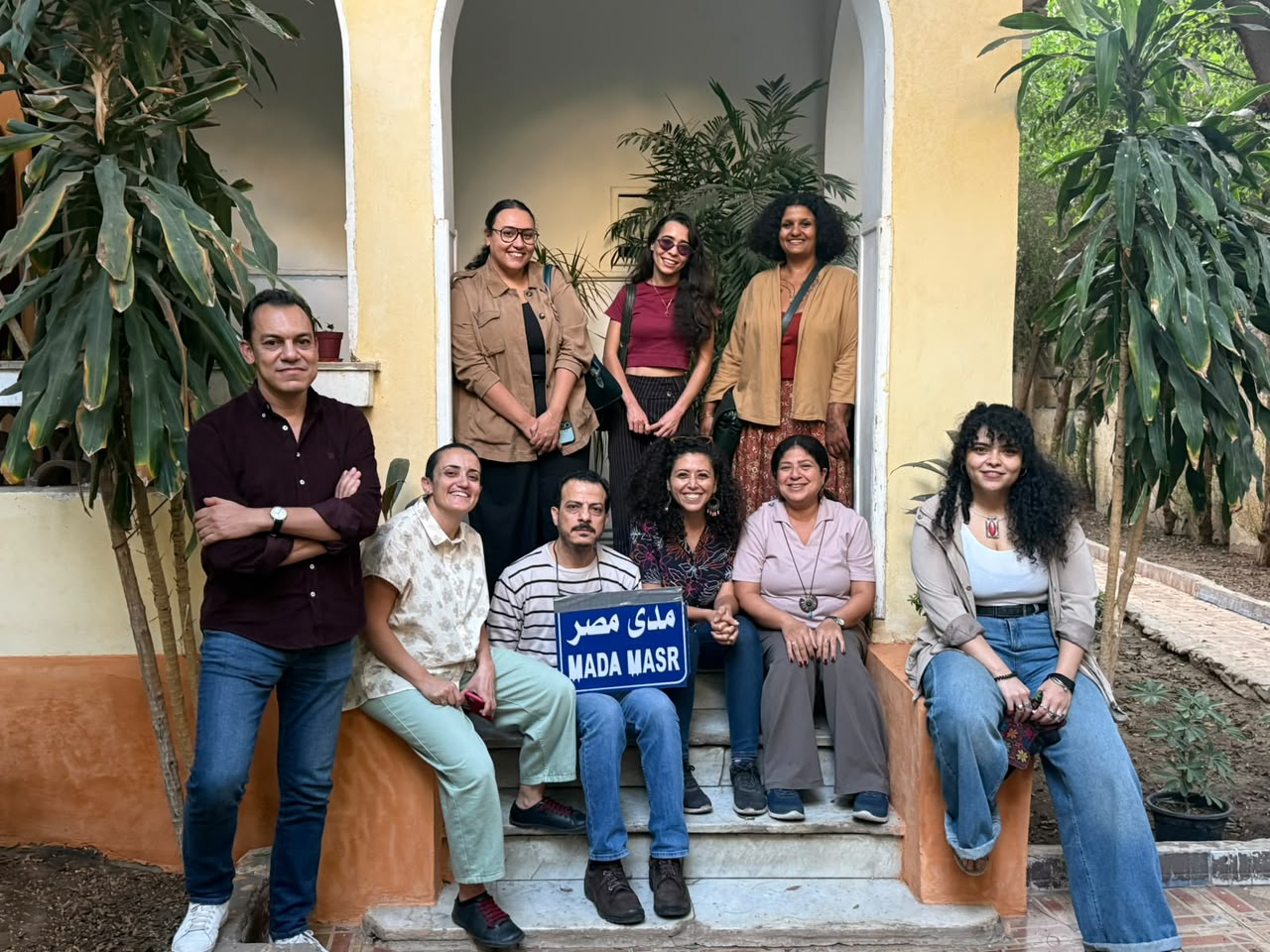
Committed to having no paywall, the 50-strong newsroom (which has more than doubled since 2013) has various streams of revenue: translations, editing, copy editing, podcast production, video production and a membership program. Now, everything has been put on pause.
Hamama says that even for an outlet used to being targeted by authorities once a year on average, this is an escalation.
“Everyone is terrified that Lina will go to prison, or that Mada will shut down,” he told iMEdD. “It’s very taxing to be in this limbo, in this uncertainty. […] I’m not ready for Lina to go to prison. Lina is not ready to go to prison. But we try to summon some energy and power to keep going another day, hoping for the best.”
No matter what happens in court – Attalah’s appeal is currently scheduled for November 25 and the retrial judge’s recusal hearing for November 26 – Hamama said they plan to abide by the rulings and then re-apply for a license.
We are not against media regulation, even though in our case it [has] become a tool of control. The way to go forward is to […] grant a license to all independent media, and that way we would be even more closely controlled. So, it’s a win-win.
Lina Attalah, editor-in-chief, Mada Masr
“We are not against media regulation, even though in our case it [has] become a tool of control,” said Attalah. “The way to go forward is to […] grant a license to all independent media, and that way we would be even more closely controlled. So, it’s a win-win. We don’t need jail sentences for journalists – and in that context, I also hope that this resolves with the liberation and the release of the Matsadaash men.”
Attalah is hopeful that the charges will eventually be dropped.
“If the authorities wanted us to suffer and be uncertain and super anxious, then this has happened. It’s been quite nightmarish in the last days. So, we feel quite punished,” she said. “I’m worried about what’s going to happen to us. But also, I’m a bit hopeful that it might be okay.”