A pianist at the edge of the stage, seated at the piano; minimal theatrical lighting; a projector; and six journalists taking turns at the microphone, recounting stories of resistance—this is how, on the evening of March 27 at Reid Hall (home to Columbia Global Centers in Paris), the atmosphere of a live journalism experience that is hard to forget took shape.
“Journalism and Crisis: Stories of Resistance,” a co-production of the Columbia Global Paris Center, the Institute for Ideas and Imagination, and the Live Magazine, brought to Reid Hall an English-language version of the format that in recent years has been filling theaters across Europe. The idea is simple but radical: instead of newspaper pages or phone screens, the stories are presented live, on stage, by the very people who lived or investigated them—without any recording or filming, without “rewind” or “replay.” Live Magazine defines itself as a “living newspaper”: what happens, happens once, and the only trace left behind is the memory of the stories.
In this edition, the audience heard “stories of resistance” through the voices of six journalists and creators who have experienced war and exile, navigated, through their work, the world of disinformation and the far right, or faced threats as reporters. Each story was accompanied by carefully selected visual material—photographs, archival footage, handwritten notes—and a unique piano composition, written and performed specifically for the evening by the pianist Magdalena Baczewska.
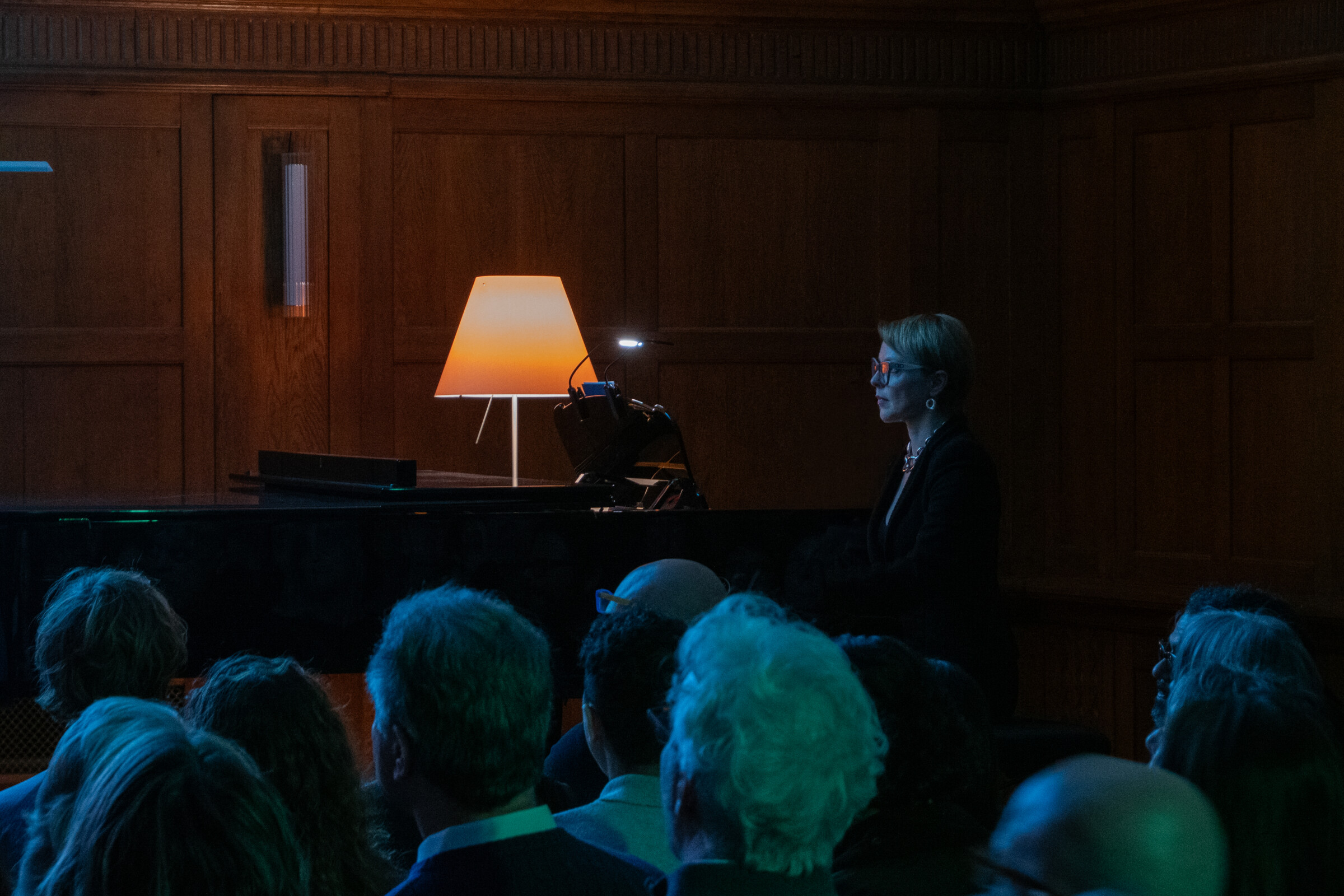
© Columbia Global Paris Center
The program opened with a war story, in which Phil Chetwynd, Global News Director of Agence France-Presse (AFP), spoke about how “the first casualty of war is the truth” and what that means when your job is to pursue it every day amidst propaganda, shocking images, and constant fatigue. This was followed by a personal journey back to the idea of “home” by a photographer who spent years covering conflicts, only to realize that trauma never stays confined to the frames of her images.
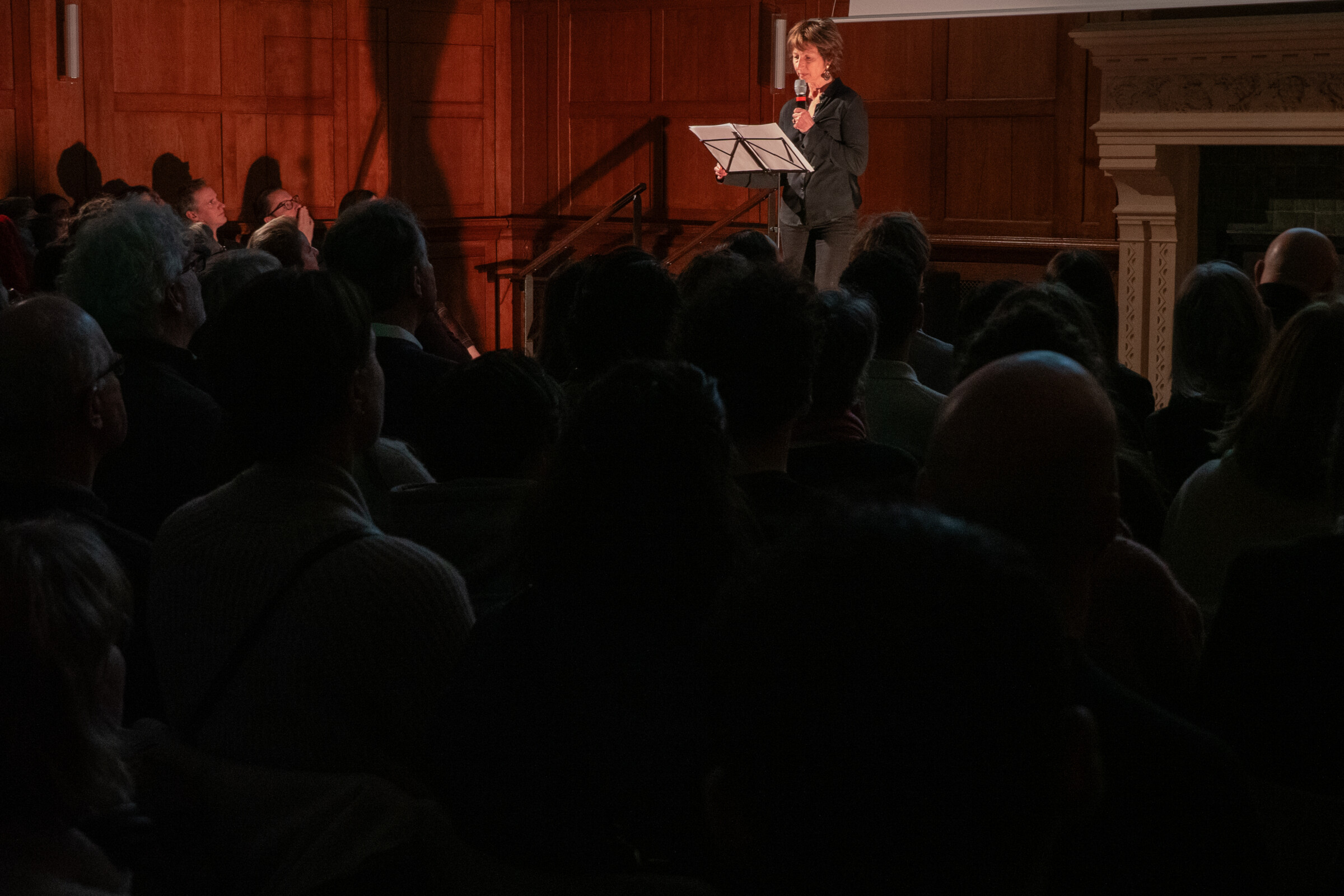
© Columbia Global Paris Center
Photojournalist Nina Berman described her own relationship with the concept of “resistance” to iMEdD: “Resistance means showing up and doing the work whatever the medium one chooses and being brave in one’s storytelling.” For her, resistance is not a grand slogan, but the persistence to appear and do the work, in any medium, with bravery in storytelling.
Resistance means showing up and doing the work whatever the medium one chooses and being brave in one’s storytelling.
Nina Berman, photojournalist
When we asked her what it was like to tell her story on stage, rather than through the usual formats of her work, she replied: “I really enjoyed it. It’s not that dissimilar to giving a lecture. What was special was being part of a group of storytellers and journalists who were so accomplished and committed. And having original music composed for my story was absolutely wonderful.”
Berman also explained what changes when journalistic work is transformed into oral storytelling: “I had to cut out a lot of extra information and distill the individual stories into very short sentences that could be delivered in a conversational way and still make sense as a complete narrative. I had to work on the timing and tone of the delivery and got help on this from the Live Magazine which I really appreciated.” For a story to stand on stage, it requires condensation, simple and clear sentences, attention to rhythm and tone—a different form of editorial work, actively supported by the Live Magazine team.
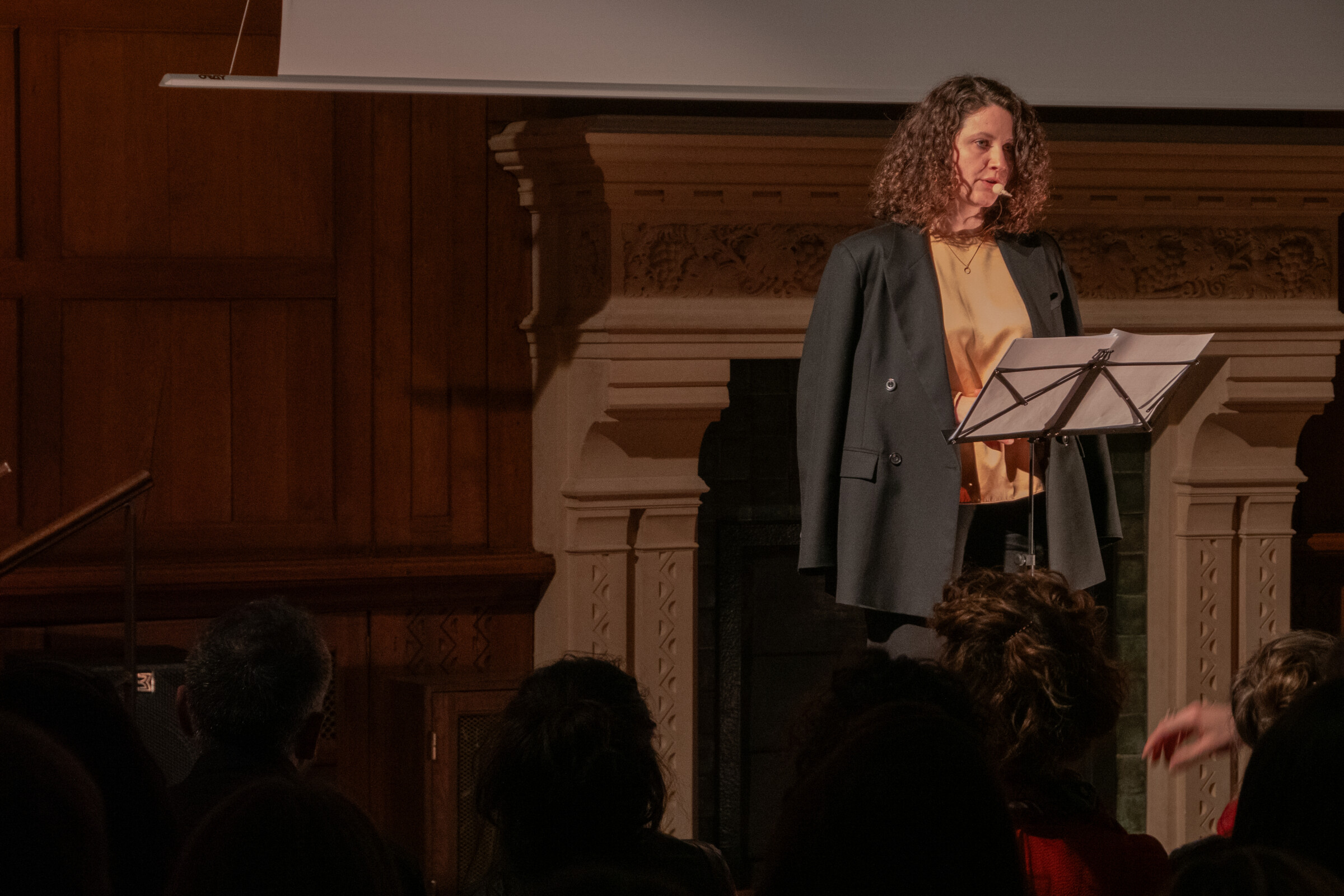
© Columbia Global Paris Center
In one of the most emotionally charged moments of the evening, a Belarusian journalist spoke about what it means to lose your school, your job, and ultimately your own country because you chose to resist. “Resistance is choosing discomfort,” said Hanna Liubakova, describing how, at the age of 14, she chose not to “comply” when the regime closed the high school—one of the country’s best—that she had just managed to enter. The school continued to operate underground in rented apartments, while the official story was that she was being “homeschooled.” “This first choice to step outside the system”, as she explained, “led to everything that followed: journalism, advocacy, exile, persecution, a sentence in absentia, the label of ‘terrorist,’ and the loss of home.”
Resistance is choosing discomfort […] Resistance is uncomfortable. But it’s also what gives life meaning. Knowing that what you do has impact—that’s the highest form of satisfaction.
Hanna Liubakova, journalist, non-resident senior fellow στο Atlantic Council
“Resistance is uncomfortable. But it’s also what gives life meaning. Knowing that what you do has impact—that’s the highest form of satisfaction,” she said, perhaps summarizing the common thread of all the stories shared that night.
For her, taking the stage is not just another format: “Every time, it is a responsibility.” In her case, she added, it means fighting against the cliché image of Belarus: “a dictator, protests that ‘failed,’ and then silence.” “But that is not the story,” she stressed. The real story, she said, is what people are doing now: how they didn’t give up, how a nation continues to evolve, how institutions are rebuilt in exile, how independent media still reach millions of people inside Belarus despite operating from abroad.
When she adapts her work into oral storytelling, she chooses simplicity: “On stage, you don’t explain everything—you let people feel it. You say less, you keep it simple, and you trust your emotions to convey the meaning.” She noted that the audience’s attention is fragile; every word must earn its place. She added one more thing: “I refuse to leave people with despair. The situation is grim, yes—but there is also strength, dignity, and hope. What I want people to see is that ordinary people, when faced with impossible choices, choose courage again and again. That is resistance. And it is stronger than any authoritarian regime.”
The evening continued in a most intriguing way. Tomas van Houtryve, an artist, photographer, and member of the VII Photo Agency, invited us on a perilous photographic journey into North Korea. By posing as a representative of a major chocolate manufacturer—claiming he could bring European expertise in chocolate production to the country—he managed to visit factories and capture rare footage. Next, Doan Bui, a reporter at French news magazine Le Nouvel Obs introduced us to the world of “flat-earthers” and conspiracy theorists. Her goal was not to ridicule them, but rather to demonstrate that these beliefs are symptoms of a much deeper crisis of trust in the media. Finally, Aïda Delpuech, a journalist and soprano from Tunisia, wove her voice together with her storytelling, speaking on the right to free speech and freedom of expression in countries where journalism remains a dangerous pursuit.
A filterless rite
What made the performance stand out was not just the subject matter, but the way it unfolded before our eyes. The narrators stood alone on stage—no podiums, no teleprompters—equipped only with a simple microphone, and their images projected behind them. The music does not serve as mere “background filler”; instead, it acts as a second voice that comments on, underlines, or pushes back against the text. The pauses, the audience’s laughter, the “chill” during difficult moments—everything becomes part of a shared experience.
The atmosphere in the hall is almost mystical. Unlike typical journalistic events dominated by panels and debates, the audience here sits in silence, much like at a theater performance, yet with the awareness that what they are hearing is real, verified, and journalistically documented. Each story concludes with brief applause, but as the night progresses, the clapping grows warmer and more prolonged, as if the audience is recognizing something deeply personal in what they hear.
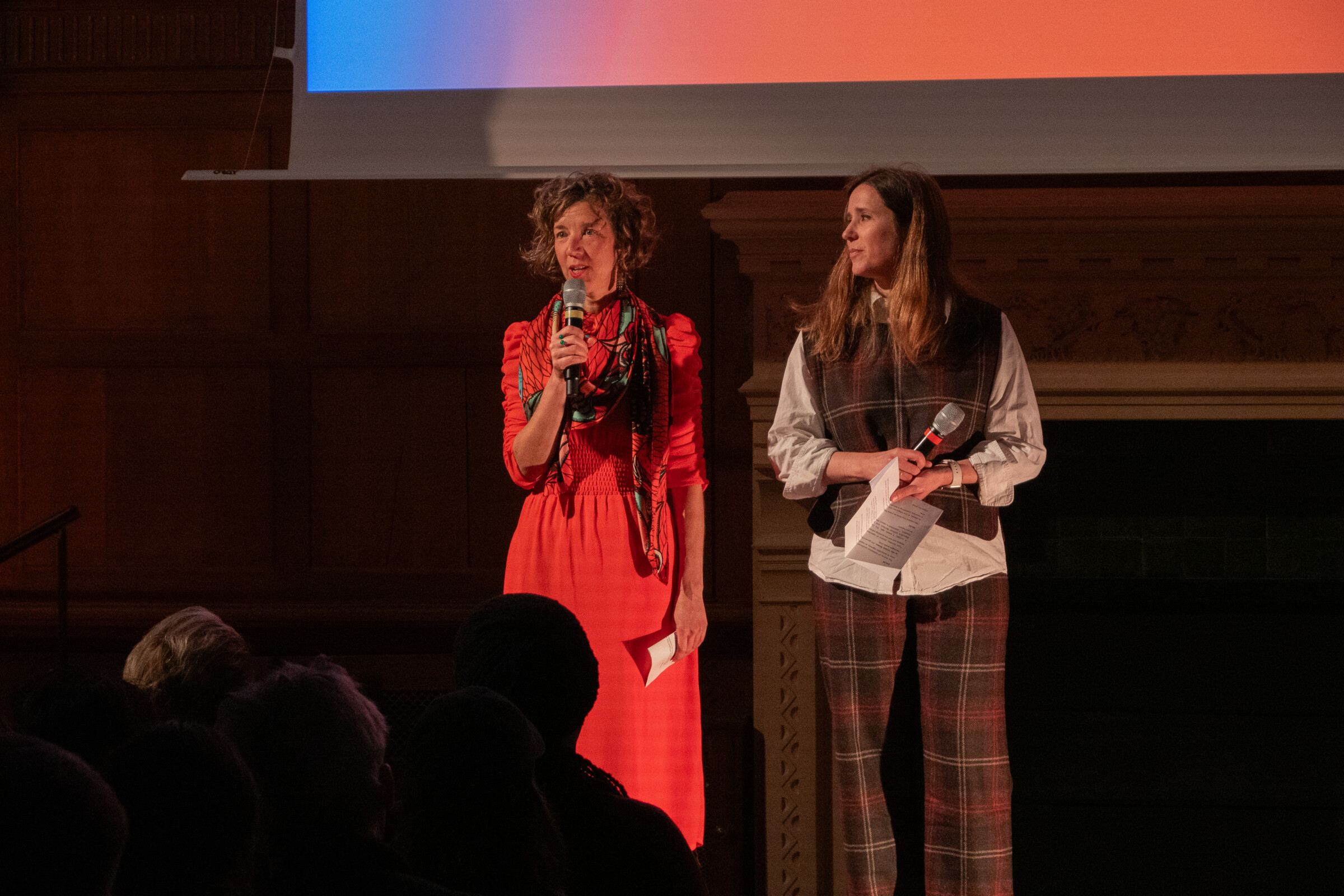
Marie Volkea Doezema, a member of the team co-curating the program, explains why the theme of resistance returned as the central axis for a second consecutive year: “Journalists are under increasing attack around the world, and the erosion of press freedom makes the theme of resistance more relevant–and more urgent–than ever. That is why we returned to it for this year’s Live Magazine at Reid Hall. Resistance is not only vital for those who report the news, but for the institutions and freedoms that underpin democratic society. It is crucial for the future of journalism, academia, and democracy itself.”
Resistance is vital for the institutions and freedoms that underpin democratic society. It is crucial for the future of journalism, academia, and democracy itself.
Marie Volkea Doezema, Paris Global Center Senior Special Projects Manager
Audience enthusiasm and the promise of live journalism
After 90 minutes, the most striking element was not just the stories themselves, but the energy they created. Audience members engaged in lively conversations, referring to specific phrases, images, or musical notes, and sharing personal memories that the narratives had “awakened.” Many spoke of the relief of experiencing journalism outside of screens and timelines, in a form that allowed them to be moved, to laugh, to reflect—without feeling like they were merely “consuming content.”
Doezema describes what she believes changes in the audience’s perception of journalism when they see it live on stage: “The format of live journalism—the journalism-on-stage approach of Live Magazine—excites me. It is a truly new format, offering a different way to connect with journalists, facts, and reporting. It is a collective and often cathartic experience in an era when such moments seem increasingly rare.” She adds that live journalism, in a very tangible way, reinforces trust and transparency between audiences and journalists.
It is a collective and often cathartic experience in an era when such moments seem increasingly rare.
Marie Volkea Doezema, Paris Global Center Senior Special Projects Manager
Live Magazine, as presented by its team, was born as a “small experiment” on a stage in Paris—a group of journalists daring to step onto the stage to tell stories that had no other platform. As Florence Martin Kessler, founder and CEO of Live Magazine, explained: “Live journalism was invented in San Francisco nearly 20 years ago by Douglas McGray under the name Pop-Up Magazine. With his support and encouragement, I started Live Magazine in Paris in 2013. When I met him and learned about what he had created—without even having attended a show—I was blown away by its audacity: a simple and classic, yet perfectly innovative format; the evidence of it; the unsurpassed promise of being together in the dark in a theater and sharing an emotional experience.”
“As program directors, curators, ‘script doctors,’ and artistic directors, we do not think of what we do as oral art. It has nothing to do with being eloquent or a ‘good speaker.’ We seek people who are the only ones in the world who can tell one specific, reported story. Then we compose and perform live music, edit audiovisual content, do scenography and lighting design—but, of course, the beating heart of what we do is the age-old storytelling. We are experts at multimedia narratives.”
Twelve years later, Live Magazine has traveled to cities from Marseille and Brussels to Beirut and Lagos, proving that live journalism is not a simple storytelling gimmick, but a serious attempt to reconnect journalism with the bodies and voices of both storytellers and audiences.
The evening we experienced at Reid Hall reminded us of something we often forget: amidst all the noise of information and screens, sometimes the strongest thing is the simplest. To be in a space together, to put away our phones for a while, to listen to a story, and then share it with others.