Illustration: Evgenios Kalofolias
Editorial cartooning: From pen to AI (and back again)
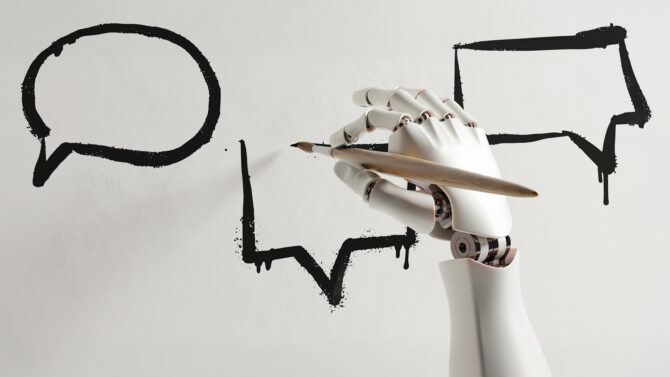
Can a cartoon be “born” from an algorithm? If so, what does this mean for the future of satire and commentary? An AI researcher and four cartoonists speak to iMEdD. The latter explain why, after experimenting, they chose to leave it out of the picture —for now.
“I want nothing more than to speak simply,” wrote Giorgos Seferis, and perhaps this is one of the greatest challenges for any journalist.
The challenge of communicating clearly for the sake of your audience—without oversimplifying, describing without judging, conveying without interpreting—is intertwined with the very nature of language itself—any language—even that of images as a form of language. Thus, the journalist faces the impossible: to transmit information stripped of personal stance, at a time when (a) every expression inherently carries a position, and (b) in an era where violations of press freedom have become normalized, this is far from the only impossibility in front of them. Given especially the second point, many of us wonder whether we should finally let go of the puzzlement around impartiality altogether. That, too, is an issue to explore.
At the same time, news storytelling seems to have incorporated attention-grabbing as a structural feature—as somehow it has become, in a sense, a product itself—and, since it is addressed to the public, it is trying to adapt to new models of public discourse (TikTok, etc.)—yet it still shows considerable awkwardness (somewhat like the uncle hanging out with the youth).
“The medium is the message,” Marshall McLuhan famously said, further complicating matters. In journalism, meanwhile, where citizens’ trust in media is below 50% globally, both the message has weakened, and the medium has been devalued.
The impact of all this on the way our shared narratives are shaped is enormous, but what I want to emphasize here is how much it determines the way we speak to one another.
Yet the only way forward is to continue talking about what matters. And if traditional modes of dialogue no longer suffice, we must rethink the forms and tools at our disposal.
This is precisely what we will attempt with the SNF Dialogues team during the upcoming SNF Nostos (June 21–28, 2026), through collaborating with the Simon Fraser University’s Centre for Dialogue. In a discussion of a different kind than the previous ones, the SNF Dialogues initiative, curated and moderated by Anna Kynthia Bousdoukou, will tackle the complex issue of “ethos” through a broad, open conversation. By using new tools and drawing on the expertise of those experienced in them, we insist on the power of speech and dialogue by all means.
And it is important to test such means while testing our reflexes in dialogue and the limits of our own scope of language. After all, these also are the limits of our world, as it’s been wisely told.