
The future of news in 2026 will balance technology, ethics, and community, keeping audiences at the center of every story. At iMEdD, we reviewed this year’s predictions and selected our highlights.
In 2026, Nieman Lab’s Predictions for Journalism reached its 16-year mark: a long-running barometer of how the news industry shifts, adapts, and fights to survive.
A review of past editions, from 2011 through 2025, reveals successive waves of disruption and reinvention. Nieman Lab maintains a very valuable archive of its predictions. Looking more closely at the emerging themes since 2021, newsrooms have wrestled with pandemic fatigue, pursued Substack ventures, expanded into audio, embraced hybrid work, and shifted from chasing clicks to building loyalty. By 2022, burnout deepened, unions gained strength, and AI quietly embedded itself into the craft. 2023 ushered in the AI era, fractured social platforms, subscription fatigue, and the rise of influencers as information brokers. In 2024, as platforms retreated, publishers confronted misinformation, political polarization, and redefined trust, diversity, and journalistic objectivity. By 2025, AI reshaped newsroom economics, creators challenged legacy media, and local news, surprisingly, showed sparks of resilience.
Having already entered 2026, we grouped this year’s 210 predictions into five broad areas: AI and automation, local and community-focused journalism, new and experimental business models, ethics, fact-checking and human judgment, and the evolving nature of audience engagement.
Here’s what we learned, highlighting the predictions that left the strongest impression.
Nick Diakopoulos: Artificial intelligence and journalism beyond the hype
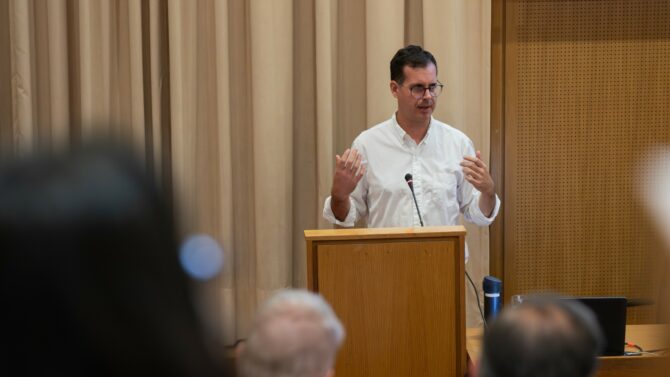
Professor Nick Diakopoulos speaks to iMEdD about how generative artificial intelligence is affecting newsrooms and journalism’s comparative advantage in content production. He comments on the competitive pressures media face in distribution and sees the opportunity for trust in journalism as still very much alive.
On the AI front
AI will continue to reshape news and newsrooms in 2026. Journalists will continue to battle AI slop, readers will interact with AI-generated content, and generative AI will ingest journalism as data.
Most experts stressed that it would become the backbone of news, for better or for worse.
Nikita Roy, the founder of Newsroom Robots Lab at the Harvard Innovation Labs, predicted that newsrooms will shift from article factories to AI-native knowledge engines, rebuilding workflows, teams, and editorial structures around value, not just legacy formats. Daniel Trielli, Professor of media and democracy at the University of Maryland, wrote that by 2026, journalism will increasingly be designed for AI systems rather than humans. This “agentic journalism” could increase reach and personalization, but will also include risks, such as reducing editorial control, deepening dependence on algorithms, and transforming journalism into a service for AI rather than the public. Susie Cagle, the enterprise editor of The San Francisco Standard, argued that to win back trust and attention from mass-produced AI content, newsrooms must make the people behind the work more visible through original voice, narrative depth, community spaces, and authentic relationships with the readers.
Meanwhile, at the local news level, journalists will use AI through vibe coding tools to prototype apps, websites, and resources. Jesenia De Moya Correa, a community engagement journalist and the creator of Huellas Media Lab, wrote that AI will assist a more participatory and action-oriented journalism, giving communities agency and accountability alongside reporters.
Community-driven journalism
“This is the year we recognize that community-rooted journalism is the foundation for any hope of rebuilding trust in news,” wrote Sarabeth Berman, the CEO of the American Journalism Project. She explained that news organizations (and the public) will recognize the value of reporters, who show up day after day in neighborhoods, schools, and city halls. JFK Fellow 2026 at Stanford University, Terry Parris Jr., also emphasized the importance of being present, “the act of being there,” proving that community-rooted journalism is the backbone of public trust.
In the same spirit, Adam Thomas, a strategic advisor for Report for the World, argued in his essay that journalism must move away from industrial, extractive, product-driven models and instead be designed and governed as “a civic commons,” echoed by technologist and consultant, Dana Lacey, where communities can shape coverage and co-steward information, technology, and legitimacy as a public resource.
Building on this vision, the focus shifts to the power of local networks and collective action. Collaboration, not outside saviors, will be the key to keeping local news alive, wrote Dale R. Anglin, executive director of Press Forward.
Experimental business strategies
By 2026, journalism can no longer rely on exposing wrongdoing to hold the powerful accountable. Paul Cheung, a strategic advisor at Hacks/Hackers and president of the non-profit Committee of 100, argued that news organizations must shift tactics: applying financial pressure, leveraging technical enforcement, intervening earlier in audience discovery, and mobilizing communities as active participants. Ben Werdmuller, senior director of technology at ProPublica, wrote that newsrooms will reclaim control over technology. Collaboration and independent, mission-aligned open-source teams “will create tools that serve core newsroom needs, including secure communication, privacy-preserving analytics, and sustainable distribution,” he added.
LaSharah S. Bunting, vice president at The 19th, predicts that the strongest newsrooms in 2026 won’t be the ones chasing every platform shift or business trend, but the ones prepared to survive multiple futures at once. As she wrote, scenario planning — practiced consistently, across teams, and before crises hit — will become a core newsroom discipline.
“Play isn’t just for kids. Joy isn’t just to be scrolled through.” Samantha Ragland, senior vice president at the American Press Institute, wrote that this year, community-focused newsrooms will prioritize joy and play alongside hard reporting. They can achieve this by designing storytelling, events, and spaces that inspire awe, connection, and creativity, they build resilience, combat burnout, strengthen civic engagement, and foster trust — making emotional and social value as central as information itself.
How young audiences are reshaping the news
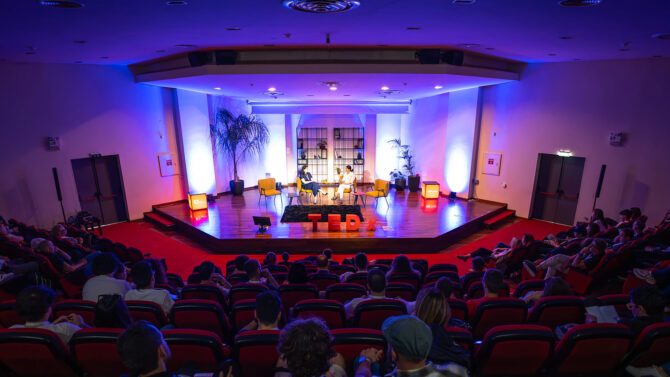
At TEDx Patras, Mitali Mukherjee highlighted the disconnect between news outlets and young audiences, urging efforts to rebuild trust.
Collective power and fact-checking
Scott Klein, publisher advocate at Newspack, predicted that 2026 will mark a revival of open-source culture in newsrooms, a necessity after a decade-long decline in code sharing and collaborative tooling. The need to collectively survive in the AI era will push journalists to “show their work” again by publishing methodologies, sharing code, and developing projects in the open.
On the opposite side of openness, Cristina Tardáguila, the founder of Agência Lupa and an anti-disinformation specialist, predicted that fact-checking will shift from politics to personal safety. As AI scams, deepfakes, and identity fraud rise, verification will focus less on campaign rhetoric and more on protecting people from deception in daily life, safeguarding finances, relationships, and personal security.
The evolving audience engagement
“I’m on TikTok now. A place I said I would never be. A place I never wanted to be. A place I never studied to be. But I’m here, and so are my peers,” wrote Dominic-Madori Davis, reporter at TechCrunch, predicting that in 2026 journalists will need to master digital presence and multimedia skills to stay relevant. They will embrace constant learning to navigate AI and layoffs in a highly competitive, attention-driven media landscape.
Even journalism schools will embrace the creator economy.
On the other hand, newsrooms will operate as support networks for independent journalists, will embrace vertical video, and audiences will shape reporting more than ever. “The audience has taken the wheel, and we’re all in the passenger seat now,” wrote Julia Angwin, founding director of a new program at Harvard’s Shorenstein Center. She predicted that publishers will compete to attract and retain creators, providing research, marketing, legal support, and tailored compensation, recognizing that audiences follow individuals, not institutions, and that empowering reporters is the key to sustaining trust, reach, and high-quality journalism.
No full stop — What journalism must carry into the year ahead

In this collection of essays, editors, reporters, and media innovators from iMEdD’s network reflect on what journalism must carry into the year ahead.
Bonus: Journalism in a chaotic world
The year began amid widespread turmoil — a reality reflected throughout this year’s predictions.
Journalists and experts emphasized that coverage from the global majority will reach broader audiences, while exiled media will seek sustainability beyond support based on grants, such as USAID.
The fight for independence, integrity, and the safety of journalists is no longer optional. Press freedom and democracy will face heightened threats, demanding unprecedented solidarity and resilience from journalists. Legal battles will become central, as reporters and news organizations team up with lawyers to defend their work and hold the powerful accountable. Journalists will increasingly embrace collective action and challenge both state-sanctioned attacks and platform manipulation.