Plus new research on: Local newspapers’ pitches for financial support, what makes for a good news interview, and Meta’s fact-checking efforts.
This article was originally published by the monthly newsletter RQ1 on March 10, 2026. Nieman Lab republished it on March 12, 2026. The article is hereby reproduced by iMEdD with permission. Any reprint permissions are subject to the original publisher. Read the original article here.
Featured image: Shutterstock, Evgenios Kalofolias
Reporting when the internet goes dark
Journalists worldwide navigate internet shutdowns, using risky workarounds to report news, exposing censorship, infrastructure failures, and personal, professional costs.
Members of the public consistently name bias as one of their top concerns about the media. The accusation that journalists tend to be left-leaning goes back half a century at least. And in many countries, including the U.S., that perception about political orientation is grounded in fact.
But to think that that confirms the bias allegations is to jump to conclusions, as Andreas A. Riedl, Stefan Geiß, Melanie Magin, Olaf Jandura, and Birgit Stark point out in their new study, published in Political Communication. After all, the model of objective journalism includes norms, values, and practices designed to keep bias in check. This model dominated in many countries during the 20th century still guides many legacy news organizations and start-ups today. So do liberal journalists actually produce left-leaning stories, or are some of these checks working to keep output balanced?
Riedl and colleagues examine these questions in the Austrian context using a huge dataset of 3,539 political and policy-related news stories from 12 news outlets, representing a variety of media and profit models. (Opinion pieces were excluded.) They analyzed the stories to quantify the presence of bias along three dimensions. The first, subjectivity, considers whether the journalist expressed a view in the news article. The second, party composition, looks at whether the representation of parties in the article was balanced. And the third, value frame composition, examines whether the article favors a certain view of political issues, expressed as either liberal vs. authoritarian, national vs. international, or market vs. welfare state. Riedl and his co-authors also surveyed 160 journalists who wrote stories in the sample.
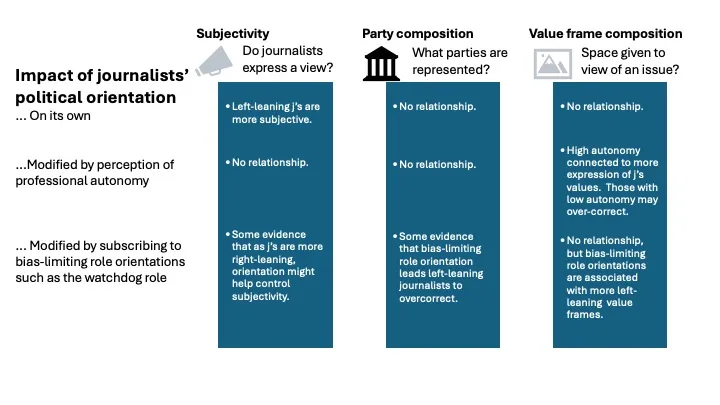
We highlight some of the key results in the graphic above. One key finding: Overall, left-wing journalists do demonstrate more subjectivity in their writing. But before Austria’s version of Newsmax gets too up in arms — overall political coverage in the country is still centrist with a slight right-leaning bias. How is this possible?
Well, it may have something to do with the moderators of how journalists think about their role and how much autonomy they have. And on top of that, the authors find that these mechanisms seem to work differently for different types of bias. So just because liberal journalists have produced more subjective work (at least in 2018, in Austria), doesn’t mean their work is biased in other ways.
For example, look at the relationship between journalists’ bias-limiting ideals about their roles and the amount of party balance in stories. Here, it’s left-leaning journalists we see playing down their bias — and to such an extent, in fact, that they sometimes overcorrect. The authors observe, “This may be because (only) journalists who emancipate themselves from role orientations perceive freedom to (over-)compensate for their own convictions.”
This may be because (only) journalists who emancipate themselves from role orientations perceive freedom to (over-)compensate for their own convictions.
On the other hand, having bias-limiting ideals about the journalist role is associated with less subjectivity for right-wing journalists. Among journalists who reject such ideals, not only do right-leaning journalists tend to become more subjective, but curiously, left-leaning journalists become less subjective. Perhaps, the authors say, left-leaning journalists who tend towards an activist interpretation of their role are more likely to ground interpretations in empirical facts; whereas right-wing journalists prize a rarefied objectivity that means not taking sides, no matter who is correct.
Meanwhile, perceptions of professional autonomy often didn’t have an impact — except when it came to value frames. Journalists with more autonomy showed more alignment between their ideology and the value frames used in their stories. “The ability to select statements and viewpoints that align with their own values seems to depend on perceiving a corresponding level of editorial freedom,” the authors surmise. Journalists who said they had low autonomy produced stories that reflected less of their political orientation, even resulting in liberal journalists producing right-leaning stories.
The ability to select statements and viewpoints that align with their own values seems to depend on perceiving a corresponding level of editorial freedom.
Ultimately, the findings emphasize: bias is no straight arrow. The relationship between how we feel about the world, and how we write about the world as we try to respect journalistic norms of objectivity and fairness, is pretty complex. That’s never going to be a popular political talking point, even if it’s a true one.
Research roundup
Opportunities missed: The untapped potential in local U.S. newspapers’ appeals for financial support by Volha Kananovich in Journalism.
Local newspapers across the United States are asking readers for money — through subscription pitches, donation requests, and paywall messages — but they could stand to make a more compelling case. That’s the central finding of Kananovich’s study, which analyzed a nationally representative sample of such appeals made by local newspapers in the U.S.
Kananovich sought to examine “the extent to which [newspapers] communicate the value of local journalism as a crucial democratic and civic institution.” She analyzed their appeals to readers through two lenses: journalism studies (specifically the concept of metajournalistic discourse, or how journalists talk about what they do) and marketing (drawing on Cialdini’s six principles of persuasion).
The picture isn’t especially encouraging. When newspapers articulated their social and civic value, the most common function cited was informing the public, but that appeared in just 22.8% of appeals. Cultivating a sense of community came in at 14.6%, accountability at 10%, and fostering public conversation and generating empathy were almost invisible at 3.9% and 0.7%, respectively. Journalistic values like accuracy or independence showed up in only 12.3% of cases.
On the persuasion side, the appeals were equally thin. Reciprocity — such as reminding readers of the value they’ve already received — was the most commonly used principle, appearing in 28.7% of appeals. Social proof, such as testimonials or showcasing statistics demonstrating popularity, was virtually absent at 1.5%.
There was one bright spot: Donation-based appeals outperformed subscription pitches in both articulating journalism’s democratic role and employing persuasive techniques. The overall takeaway, however, is a sober reminder: At a moment when the survival of local news may depend on news organizations convincing communities of their worth, many newspapers are struggling to make that argument.
What factors create a positive interview experience? Insights from news sources to increase media engagement by Kathryn Shine in Journalism Practice.
Journalism education and research have had plenty to say about how reporters should conduct interviews — but what do the people on the other side of the conversation think? This study flips the lens, surveying 220 Australian media experts and spokespeople about what makes for a good (or bad) interview experience with journalists. This is particularly important to know at a time when there is emerging consensus that news coverage should include more diverse voices, and that white, male perspectives tend to be over-represented.
Through a thematic analysis of open-ended survey responses, Shine identified five overarching factors that sources say matter most: preparation, respect, clarity, time, and open-mindedness. Preparation emerged as a key theme — sources want to know that a journalist has done their homework before reaching out, both to demonstrate competence and to signal that the source’s expertise is valued.
Respect encompassed everything from professional courtesy to follow-up practices, with many sources saying they appreciated receiving a link to the published story or feedback after the interview. “Respect was demonstrated through a reciprocal, rather than transactional, interaction whereby the journalist continued to engage with them even after the interview had concluded,” Shine writes.
The time factor offered several revealing dimensions. Sources didn’t necessarily want short interviews — they wanted to not feel rushed, and they wanted flexibility around scheduling. Several expressed frustration about long interviews that were condensed to a single quote or not used at all. “Make it easy for me. I am time poor,” said one woman working in the public sector.
Open-mindedness, meanwhile, was about journalists arriving without a predetermined narrative — sources were put off when they sensed a reporter was looking for a quote to confirm an existing angle rather than genuinely engaging with what they had to say.
Notably, 77% of respondents described their overall interview experiences as positive (versus only 6% reporting a negative experience), and willingness to participate was high across the board. But women reported significantly greater nervousness about being interviewed and lower confidence in what they had to offer, suggesting that journalists can do more to help people feel at ease and empowered when they are invited to be interviewed — and thereby help to reduce the well-documented gender gap in news sourcing.
Public affairs news and local relevance in digital journalism: Comparing nonprofit versus commercial digital news outlets across levels of community pluralism by Hsin-Han Lee and Wilson Lowrey in Journalism & Mass Communication Quarterly.
The problems of local news are many and well-studied, but an intersecting set of questions remains underexamined: To what extent are nonprofit news sites offering higher-quality local journalism compared to their commercial counterparts? And how does the composition of a community make a difference in this situation?
In this study, Lee and Lowrey conducted a content analysis of 672 news stories from 16 local digital startup news sites — eight nonprofit and eight commercial — spread across communities with varying levels of structural pluralism (essentially, a proxy for community size and institutional complexity; big cities tend to be “high” on pluralism because they have larger populations and a more distributed power structure).
The nonprofit advantage was clear across the board. Nonprofit outlets produced significantly more local content (83.6% versus 72.9% for commercial sites), more original reporting (95.2% versus 80.7%), and substantially more public affairs coverage (87.2% versus 62.5%). When the researchers controlled for other factors, the profit orientation of an outlet remained a significant predictor of content type — nonprofit stories were about twice as likely to be locally relevant and more than six times as likely to be written by local staff compared to commercial outlet stories.
But do these benefits of nonprofit newsrooms hold up in smaller urban areas, or are they unique to major metros? The researchers found that while news-quality benefits from nonprofits to be beneficial for both types of communities, “nonprofits were more effective in the largest cities. Perhaps, given their strong public-affairs goals, nonprofits are more eager and more expertly staffed to take advantage of the institutionally rich environment of large cities and are more likely to thrive journalistically amid the greater complexity and conflict of diverse institutional sources.”
Funding without strings: The case for IJ4EU’s investigative journalism support model by Marius Dragomir in Journalism Practice.
Europe has faced a deteriorating environment for investigative journalism in recent years: from growing political interference to the decline of legacy media business models that underwrite such investigations to the sinking public trust in journalism. It’s a pattern that looks familiar in other regions, too. Can hope for renewal be found in new donor-driven initiatives?
The Investigative Journalism for Europe (IJ4EU) program offers a compelling test case. Launched in 2018 with core backing from the European Commission and co-financing from philanthropic foundations, IJ4EU has financed more than 150 cross-border investigations across 36 countries, with results published in over 700 media outlets.
Dragomir evaluated the program through three consecutive funding editions (2020–2022), drawing on a mixed-methods approach that included document analysis, journalist surveys, semi-structured interviews, case studies, and media content analysis. The study’s findings paint a broadly positive picture — but with caveats. IJ4EU’s governance model, characterized by a strict firewall between donors and editorial decision-making, earned praise for its credibility, transparency, and lack of bureaucratic bloat. Neither the European Commission nor private donors exerted any influence over the investigations funded. Projects were selected through an independent jury, and grantees described the process as streamlined and journalist-friendly.
“Donor funding has long been accused of breeding volatility, inviting mission drift, or exerting subtle editorial pressures,” Dragomir writes. “This article argues that the IJ4EU model offers a refreshing counter-narrative: a journalist-led, arms-length framework that insulates editorial processes from funder interference while actively encouraging transnational collaboration.”
The program has also made strides toward regional equity, particularly through its Freelancer Support Scheme (launched in 2020) and efforts to increase participation from Eastern Europe — where journalists constituted 35% of all project members by 2022, up from 25% in 2021. Yet persistent disparities remain: only 10% of project leaders were from Eastern Europe in 2022, a drop from 25% in earlier cycles.
And while IJ4EU has alleviated immediate financial pressures for many investigative reporters — nearly two-thirds said the funding was essential to their professional survival — it can’t resolve on its own the deeper structural challenge of donor dependency: namely, that grants provide “vital lifelines but rarely translate into sustainable business models once funding ends.”
Still, the study points to the potential of this model to help support investigative journalism around the world: “What makes IJ4EU truly distinctive is its replicability,” Dragomir writes. “Its design…offers a blueprint that could be adapted across regions, from Southeast Asia to Latin America. In doing so, it could help re-anchor journalism as a public good in contexts where market collapse or political pressure have all but silenced watchdog reporting.”
From moderation to chaos: Meta’s fact-checking and the battle over truth and free speech by Regina Cazzamatta in New Media & Society.
In the collective freak-out about the potential impact of misinformation in 2016, in the wake of the Cambridge Analytica scandal, Brexit, and Trump’s first election, Meta (then known as Facebook) enlisted teams of fact-checkers worldwide to help. Eventually, Meta’s third-party fact-checking program expanded to 119 countries and funded independent organizations accredited by the International Fact-Checking Network.
But it all unraveled in early 2025. Meta, responding to mostly right-wing populist charges of bias in fact-checking, announced that it was scrapping its fact-checking initiative in favor of a Community Notes-style system. This raised a question: What did fact-checkers actually do under the old arrangement that lasted nearly a decade?
This study offers an important look at the work behind the scenes. It draws on a content analysis of 2,053 debunking articles produced by 16 Meta fact-checking partners across eight countries in Europe and Latin America (two regions where Mark Zuckerberg accused regulators of being overly censorious), along with 30 expert interviews with fact-checkers themselves. (Parenthetically, it’s worth noting that, contrary to popular belief, fact-checkers lack the authority to remove or censor content; their role is to offer help with verification.)