In co-authoring a book with Virginia Roberts Giuffre about her trauma and exploitation within Jeffrey Epstein’s orbit, journalist Amy Wallace leaned on the fundamentals of reporting — interviews, verification and documentation — not simply as tools, but as the structure underpinning the narrative.
Featured image: Evgenios Kalofolias
“I hope for a world in which predators are punished, not protected; victims are treated with compassion, not shamed; and powerful people face the same consequences as anyone else. (….) If this book moves us even an inch closer to a reality like that — if it helps just one person — I will have achieved my goal,” Virginia Roberts Giuffre wrote in the closing pages of Nobody’s Girl: A Memoir of Surviving Abuse and Fighting for Justice.
For more than a decade, Giuffre stood among the most recognizable figures to emerge from the Jeffrey Epstein sex-trafficking scandal. From the age of 16, she was trafficked by Epstein and his associate Ghislaine Maxwell. Then she was allegedly abused by powerful men, including billionaires, politicians and royalty.
In 2011, she publicly identified herself for the first time as one of its victims and began speaking openly in lawsuits, depositions, and interviews. By recounting years of abuse and suffering on repeat, Giuffre hoped to help protect other victims and encourage them to come forward.
In April 2025, she committed suicide.
Less than a year later, on January 30, 2026, the U.S. Department of Justice released more than 3 million Epstein-related pages, along with 180,000 images and over 2,000 videos, under the Epstein Files Transparency Act signed in November 2025.
For four years before her death, journalist Amy Wallace worked alongside Giuffre as the ghostwriter of her memoir. She had not intended to publicly identify herself as a co-author but chose to do so after Giuffre’s death. Speaking to iMEdD from California, she says her role was not only to help shape the narrative, but, as a journalist, to ensure its accuracy.
From AI tools to Prince Andrew’s arrest: How newsrooms are digging into the Jeffrey Epstein files

Editors from the BBC, the New York Times, the Guardian, the Miami Herald and Bellingcat on the tech, communities and strategies helping them cover the story.
The basic “skills of digging”
In April, speaking at the International Journalism Festival in Perugia, Amy Wallace described the process of co-writing Giuffre’s memoir as, in many ways, an extension of ordinary journalistic work.
Reporting and feature writing, she notes, had prepared her for the peculiar demands of this multilayered project: listening closely, checking details obsessively, earning Guiffre’s trust, and shaping a traumatic testimony into a narrative intended not only to document suffering, but to reach others living in silence.
Wallace began her career in newspapers almost three decades ago, including at The New York Times and The Atlanta Journal-Constitution. She learned the profession through repetition and proximity: interviewing sources, asking uncomfortable questions and mastering the granular mechanics of reporting, from chasing leads to pulling court records.
Co-authoring Guiffre’s memoir as a journalist, Wallace tells iMEdD, came down to the basic skills of research any reporter would need to master for any type of story. “One of the jobs of writing, being a ghostwriter, but also writing any book, is that you have to corroborate what you’re saying. That’s obviously the fundamental part of reporting,” she says.

She emphasizes the importance of knowing how to gather proof, what she described in Perugia as “the basic skills of digging”.
Gathering all public documents about Guiffre was her own starting point for the book.
Wallace says her role was also to “bulletproof” the narrative through exhaustive verification. That meant revisiting all Giuffre’s interviews, reading through extensive press coverage and books on Jeffrey Epstein, and systematically cross-referencing thousands of public court filings, including documents made public through related litigation.
One of the jobs of writing, being a ghostwriter, but also writing any book, I think, is that you have to corroborate what you’re saying. That’s obviously the fundamental part of reporting.
Amy Wallace, journalist and co-writer of Virginia Roberts Giuffre’s memoir Nobody’s Girl: A Memoir of Surviving Abuse and Fighting for Justice.
Talking to sources
To deep research, Wallace added personal connection.
Talking to sources is not approaching them through flattery, she says. “The way that I have learned really works with any kind of person, whether they’re famous or illustrious in their fields, is if you do a bunch of research around them so that you really know what you’re talking about,” she adds.
“And I cannot overstate the benefits of being prepared. It sounds boring, but it’s really important, because it changes the texture of the conversation. People want to stay longer. They want to talk to you more. They give you more time.”
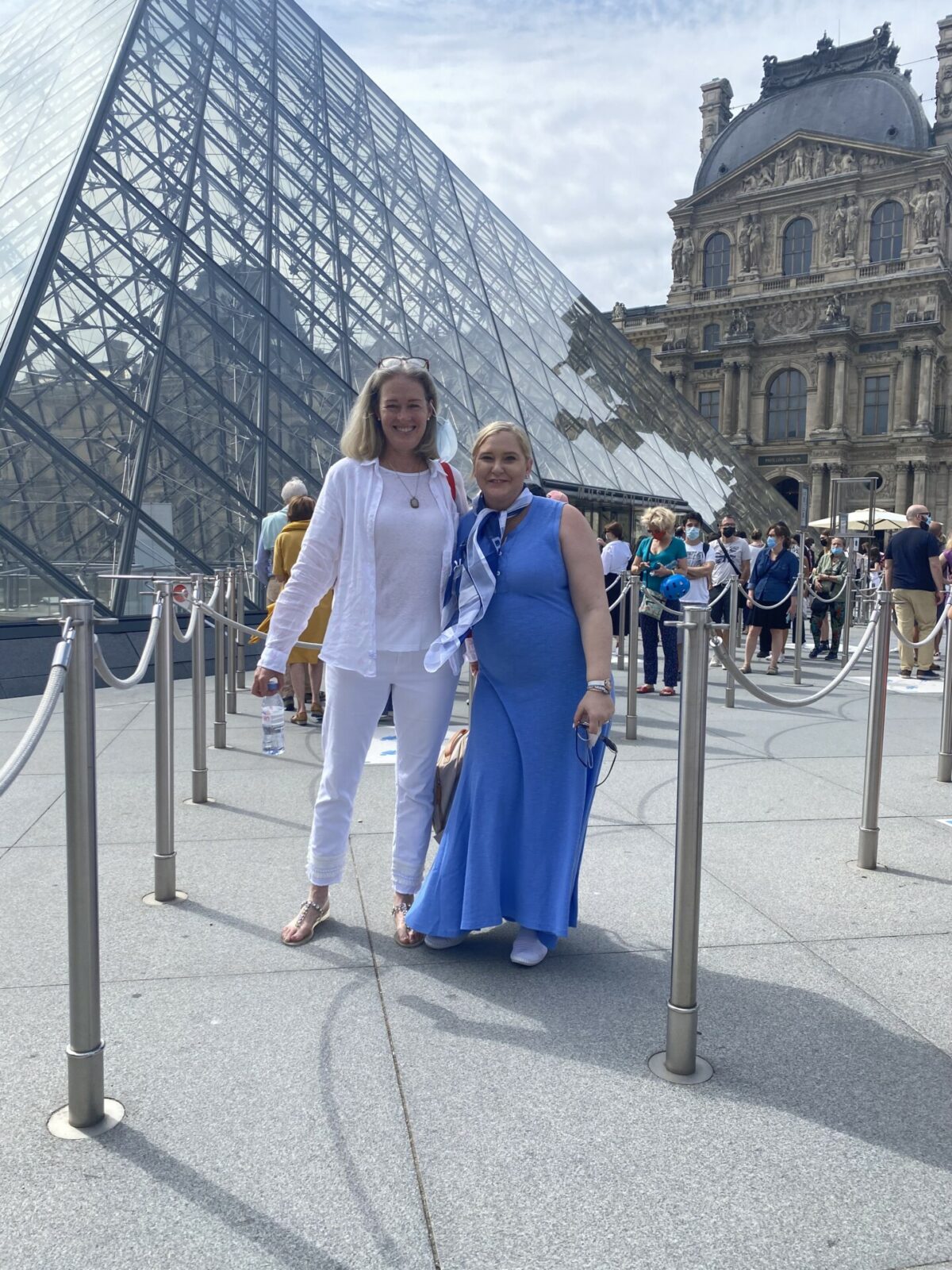
She first met Guiffre in person June 2021. The two had already spent weeks speaking over Zoom about the memoir Giuffre hoped to write. They met in Paris, where Giuffre had traveled to assist prosecutors seeking to keep Jean-Luc Brunel, a French modelling agent and longtime associate of Jeffrey Epstein, in prison.
During the meeting Guiffre confided that she was not able to return to the Louvre, not even to see the Mona Lisa, because she was living a flashback of being there with Epstein and Maxwell. In those early days of getting to know each other, Wallace suggested they go back to the Louvre room together.
“I said, well, you know, we could go back. We can take that place back from them. We went back and went straight to that room. I held her hand and we sat on a bench. We took that beautiful place back for her,” said in her talk in Perugia, emphasizing the importance of building a relationship before turning to traumatic events.
Live journalism at Reid Hall: six stories of resistance on stage

“Stories of resistance” through the voices of six journalists and creators who have experienced war and exile, navigated, through their work, the world of disinformation and the far right, or faced threats as reporters.
Why details matter
Working with a story emerging from the Epstein scandal, which was already shaped by speculation, Wallace went beyond her conversations with Giuffre, enriching the narrative with additional reporting and detail.
“The goal of any good writing — not just ghostwriting, but writing more broadly — is to help the reader feel it, see it, smell it, hear it. You want to put them there, to bring them into the scene as much as possible. Details do that. It also gives a piece its voice. It feels authentic because the writer is specific about what they saw, felt, or heard,” she says.
The goal of any good writing — not just ghostwriting, but writing more broadly — is to help the reader feel it, see it, smell it, hear it. (…) Details do that.
Amy Wallace, journalist and of Virginia Roberts Giuffre’s memoir Nobody’s Girl: A Memoir of Surviving Abuse and Fighting for Justice.
“And that was really important for Virginia’s book, particularly because her goal was to help other victims of sexual abuse by showing what it feels like to be a teenager or young girl who feels trapped. To bring that to life, you have to draw the reader into the experience itself. And you do that through detail — whether it’s the pattern of a blanket on a bed, or the squeak of a door as it opened and closed.”
She adds that Guiffre had an “unusually strong memory”, making it relatively easy to recover specific details.
The challenge, Wallace says, laid in using details effectively, placing them where they belonged within the narrative. So, she fact-checked and did some shoe leather reporting.
Among other places, she traveled to Loxahatchee, Florida, visiting where Guiffre grew up. She also went to the empty lot in Palm Beach where Jeffrey Epstein’s house once stood — the place where Giuffre said she was first abused.
“I [also] talked to a lot of people around her who knew her at different points in her life, including childhood. So that’s corroborating evidence. Anyone who’s reported on sexual violence knows it’s very important to find people who heard it at the time.” She says she ensured she interviewed sources across different periods of Giuffre’s life who could corroborate her experiences and events.
“That’s just journalism,” she says.
A strong organization system
Writing a story of a victim of sexual abuse needed a strong organization system.
“I love a three-ring binder,” she says to iMEdD. “I know it sounds old school, but it really isn’t. It gives you a physical place where everything lives.”
Wallace says she worked with extensive visual and documentary material to reconstruct the timeline of Giuffre’s account. She describes using photographs and large annotated calendars to cover the time Giuffre spent with Epstein and Maxwell. This method helped her map where each of the three was believed to be on any given day.
The chronology, she notes, was built from multiple overlapping sources: partial flight records from one of Epstein’s pilots helped establish who was traveling where; passenger notes in those records indicated when Giuffre was on the plane. Maxwell, she adds, was frequently photographed at public events by party photographers around the world, allowing Wallace to place her in cities such as London and New York at specific times. To cross-reference these details, Wallace says she searched image archives such as Getty Images. She then printed photographs from their public appearances and assembled them alongside her calendars and flight data.
The result was a dense system of verification used in multiple ways to triangulate events. or “just the tip of the iceberg,” she adds.
Writing in another person’s voice
Giuffre’s memoir is largely chronological. She speaks directly to the reader, taking them through the story of her abuse.
“Chronology is an easy structure for readers to follow, but we also felt it was important to understand what happened early in her life, before later events,” she says. That context helped explain why Guiffre may have been more vulnerable to manipulation and exploitation — something that is true for many of the Epstein survivors. “You really had to understand her life as a whole,” she adds.
However, given the intensity of some of the book’s most traumatic passages, Wallace and Giuffre decided to insert pauses — “breathers,” as they called them — to give readers space. It was a deliberate device, Wallace says, intended to help readers continue through the narrative.

Writing in someone else’s voice, Wallace says, drew on her background in magazine profile writing, where the aim was always to capture how subjects sounded and carried themselves. That experience, she notes, became useful in ghostwriting. It required extensive interviewing, recording and transcription — a process she has now repeated across several books.
“Obviously, you still have to fill in gaps, and that becomes your writing. But the important part of the process is that you then give the writing back to them and edit it together — asking, ‘would you say it this way?’”. That, she says, is a crucial part of capturing the voice.
Working with trauma survivors
Wallace described sensitivity as a practical discipline as much as an ethical one in a book that circles around trauma. Interviews were paced around Giuffre’s ability to revisit traumatic material, and conversations were often paused or reshaped in real time when emotion overwhelmed the room. “We would always talk in advance about what we were going to cover, and I would ask her if she felt up to it — whether it was the right day for that topic,” she says.
Giuffre, she noted, had long been required to repeat her story publicly and at times recounted it in a detached, protective register. Other times, she was omitting details she may have registered in her mind in a different way. “Well, one lesson I learned is that Virginia’s memory was remarkably strong. I don’t think the book would exist without that. But what I didn’t know before is that, particularly for trauma survivors, a way of coping isn’t necessarily to change a memory, but to place it somewhere else in the mind — almost in a different room,” Wallace says.
The book, she adds, was in part an attempt to allow Guiffre tell it all once, fully and carefully, so she would not have to keep returning to it.
Ultimately, even within a professional framework, she added, the work demanded something closer to sustained attentiveness between two people than to traditional reporting alone — without losing sight of accuracy, but refusing to separate it from care.