An application developed by data journalist Thanasis Troboukis visualizes public contracts of the central government and local authorities in Greece, as well as the data behind wildfires, and sheds light on the actions taken by the state on fire protection.
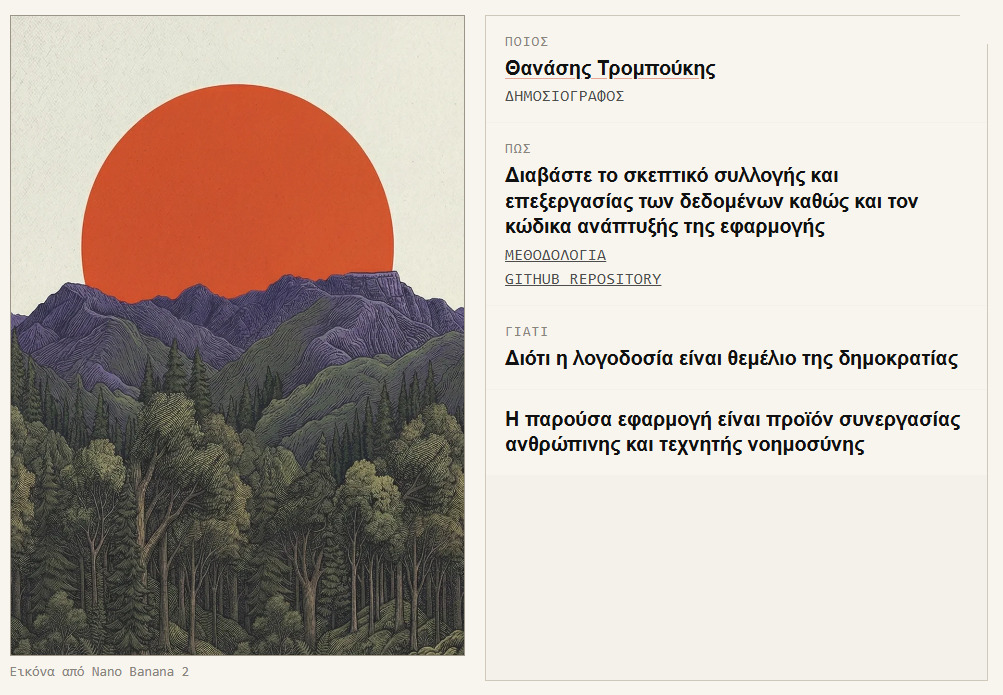
Featured image: The visual of FireWatch app by Nano Banana 2.
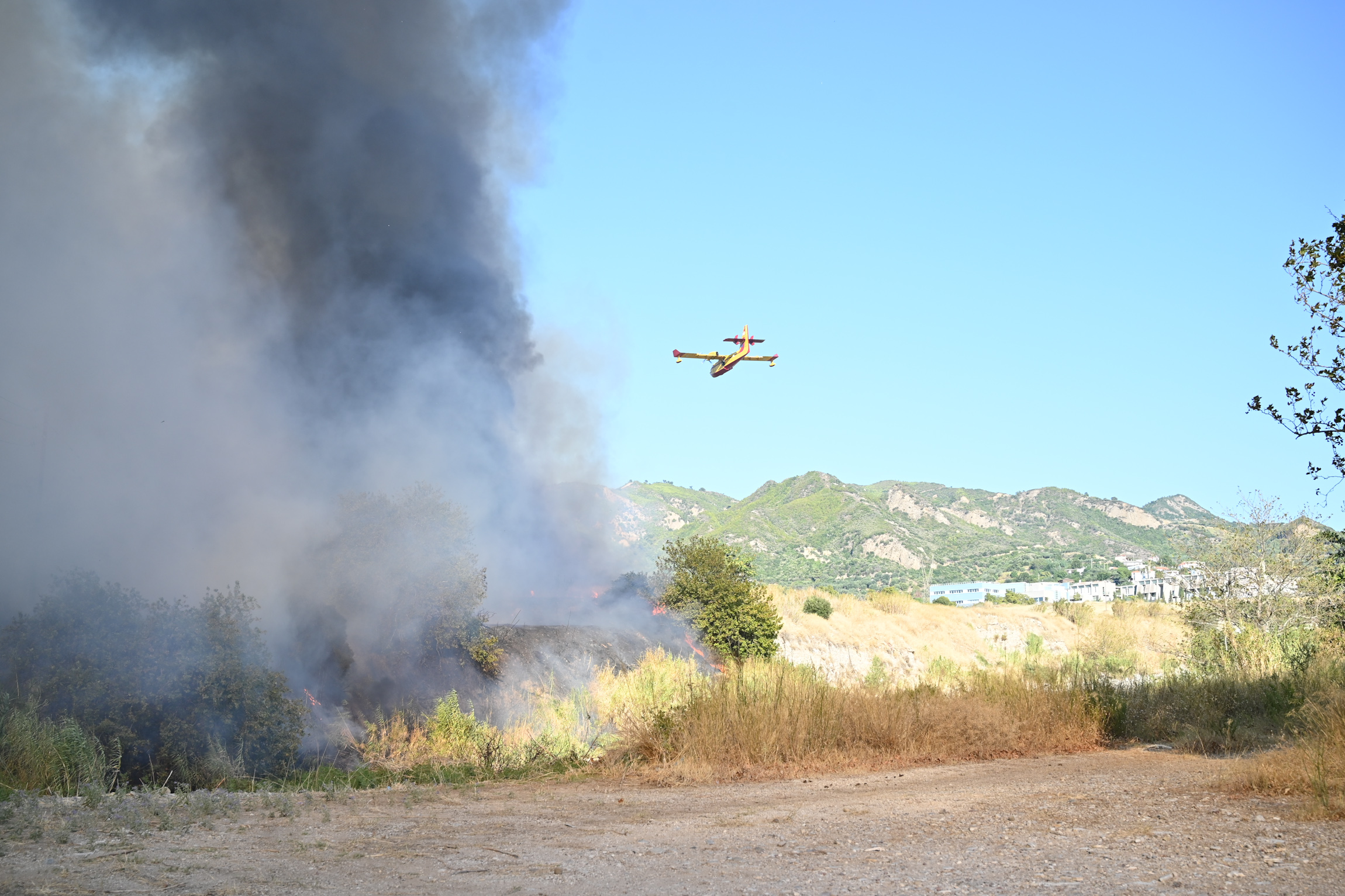
With the start of the fire season on the 1st of May, the debate in Greece often revolves around the actions—or lack thereof—taken by the government and local authorities to prevent wildfires. Usually, the catalyst for the reignition of this debate is usually a wildfire that breaks out and burns large swaths of forest and crops, thus triggering a blame game among all involved parties —especially if property damage occurs.
Τhe web application Firewatch, created by data journalist Thanasis Troboukis, attempts to shed light on the opaque realm of public contracts (from municipalities, ministries, etc.) for the prevention and management of wildfires, while also analyzing the most recent data on the total area burned, as well as the latest incidents being handled by the Fire Department across the country.
“What is the municipality doing”, “where is the state” and other questions
“My own need—and that’s how this app got started—was to answer the question, whenever a fire breaks out, whether fire prevention measures had been taken earlier in that specific area,” said Troboukis, when asked about what motivated him to create the FireWatch app.
“When fires break out, you [often] see residents on TV giving interviews and saying, ‘the plots were overgrown,’ ‘what is the municipality doing?,’ ‘where is the government?,’ and all these questions. We usually assume the answers to these questions, but I personally felt the need to have more solid data on which to base my opinion about what happens each time during a fire. It started as a personal question, and it seems to concern far more people than I expected,” he added.
When fires break out, you [often] see residents on TV giving interviews and saying, ‘what is the municipality doing?,’ ‘where is the government?,’ and all these questions. We usually assume the answers. I personally felt the need to have more solid data on which to base my opinion about what happens each time during a wildfire.
Thanasis Troboukis, data journalist and creator of FireWatch app
What the app displays and from which sources
The app presents the topic on two “levels”: firstly, the incidents, i.e., forest fires, and secondly, the public sector contracts for fire protection.
The first level displays active events—that is, fires currently in progress—using data published on the Fire Department’s website. In addition, users can also locate the burned areas left behind by the fire fronts, as recorded in satellite data from the European Copernicus service (starting in 2025), or in data from the Fire Department (for the time span 2000-2024), as well as the thermal anomalies of the past 24 hours, according to NASA FIRMS.

The second level of the application analyzes public contracts related to fire protection.
To identify, on the one hand, what work was performed for each contract, and, on the other hand, within the contracts those that actually concerned fire protection, the CPV code is used. As Troboukis explained, this is a code for the work described in public contracts and is common across all European Union countries.
The source of the data on public contracts is KIMDIS, where all the public contracts over 2.500 euros is uploaded. This information is updated four times a day, from 7 a.m. to 7 p.m. On the other hand, data on wildfires is updated approximately every hour, and, as Troboukis noted, the goal is to update it even more frequently in the near future.
A large part of journalists’ daily routine in newsrooms during the summer involves covering wildfires that have broken out across the length and breadth of Greece. With this app, journalists will be able to further analyze the data behind the fire by viewing the municipality’s “profile” in terms of fire protection:

- how many acres have been declared for clearing
- the contracts
- the water tankers and fire trucks it has available
- the area
- the population
- the wildfires that have aflicted the area
- how many statements of plot clearing have been filed (2024 data)
- where fire protection projects have been carried out (marked with yellow dots)
- funding for fire protection expenses
- the companies contracted to carry out these projects, as well as the type of contract (direct award, etc.)
What can’t be seen in the app? The work carried out by municipalities using their own resources. “This type of work doesn’t appear in the app and couldn’t appear, since there is no registry that records all the work done by municipalities or agencies,” Troboukis explained.
Vibe coding in the development of the app
In the bottom right corner of the application is noted that “this application is a product of collaboration between human and artificial intelligence”, meaning that part of the app was developed through interaction with artificial intelligence systems, somewhat reminiscent of vibe coding—that is, writing code with the help of LLMs and text prompts.
“It wasn’t exactly vibe coding as you might imagine,” Troboukis explained when we discussed the more technical side of the app. “I started by writing the code myself, for the analysis, in Python, and creating the initial layout in React JS, and then I fed it into Codex so it could implement it more correctly, because my knowledge of React isn’t that advanced.”
However, the capabilities of artificial intelligence systems in developing such applications appeared to have certain limitations in the case of FireWatch. “I basically did the data cleaning myself, because Codex couldn’t make sense of the Greek characters and the way, for example, municipalities were referenced in different public data sources,” emphasized Troboukis.
The application’s front end is built using React, a widely used framework. As Troboukis explained, he used artificial intelligence tools at this stage. “I know the basics and the logic behind developing a React application, but I don’t have the experience to build such an application from scratch. I built the basic components the way I knew how, asking ChatGPT or Codex along the way, because the idea was to learn as I went,” he said, emphasizing, however, that “because it was making decisions that didn’t help ensure the accuracy of what we were displaying, it really required you to go back to every component you built and review them. The same went for the database: I created an entity diagram because it’s a relational database, and I fed it into Codex so it could start generating the SQL queries needed to join the relevant tables and then connect them to the platform where the database is hosted.”
It’s vibe coding, but if someone didn’t know how to code, it would be very difficult to complete it.
Thanasis Troboukis, data journalist and creator of FireWatch app
“Vibe coding” has various interpretations. As Troboukis explained, in his own context it was something like “supervision.” “You yourself can ask it to build you a React app,” he emphasized. However, creating a React application using only Codex and without any prior knowledge of coding can lead to difficulties, he explained.

“For example, in the app, one component is the latest contracts. What a latest contract looks like, what elements it contains, etc. While you’d expect Codex to build the components on its own and split the app into components on its own, it didn’t do that. Either it created its own component or it didn’t create any component at all, and it did it all with TypeScript. So, it required you to “jump right in.” It’s vibe coding, but if someone didn’t know how to code, it would be very difficult to complete it,” Troboukis said.
The part of the application where he relied mostly on this “vibe coding” strategy was in testing the website for its efficiency and speed. “I wanted to test how long it takes for the site to load, how we could improve it, how many database queries are made, and what strategic approaches we could take to reduce the number of queries so we wouldn’t fetch data the user hadn’t actually requested. That’s where I used vibe coding to adjust the strategy”, he noted.
The reaction from the community and the impact of open sources
Thanasis Troboukis announced the launch of his app in a social media post on the 30th of April a few hours before the official start of the fire season. One group that has found the app particularly interesting is the journalistic community.
“I can say [the general reaction] is enthusiastic. It has received very positive comments. Many journalists have shown interest, not only in terms of interviews but also to understand how the data is analyzed. I’ve received very positive feedback. And not just from journalists, but also from non-governmental organizations and other environmental groups,” said Troboukis.
Many colleagues are learning for themselves that they can access public contracts. And that’s a positive thing—that the journalism community is inspired to produce stories based on open data.
Thanasis Troboukis, data journalist and creator of FireWatch app
The impact of the application is multifaceted, he explained, emphasizing that FireWatch is a tool for everyone.
“It’s definitely about seeing what’s happening, and this doesn’t just concern journalists; it concerns citizens as well. It’s not a tool aimed at the journalistic community; it’s a tool aimed at everyone. From this perspective, everyone has shown interest—whether as a journalist or because they wanted to understand how it was built and the technical aspects behind it,” he emphasized.
Another impact the app had was that users discovered new sources of open data that they might previously have considered nonexistent or inaccessible.
“Many colleagues are learning for themselves that they can access public contracts. And that’s a positive thing—that the journalism community is inspired to produce stories based on open data that they might not have known existed out there,” he concluded.