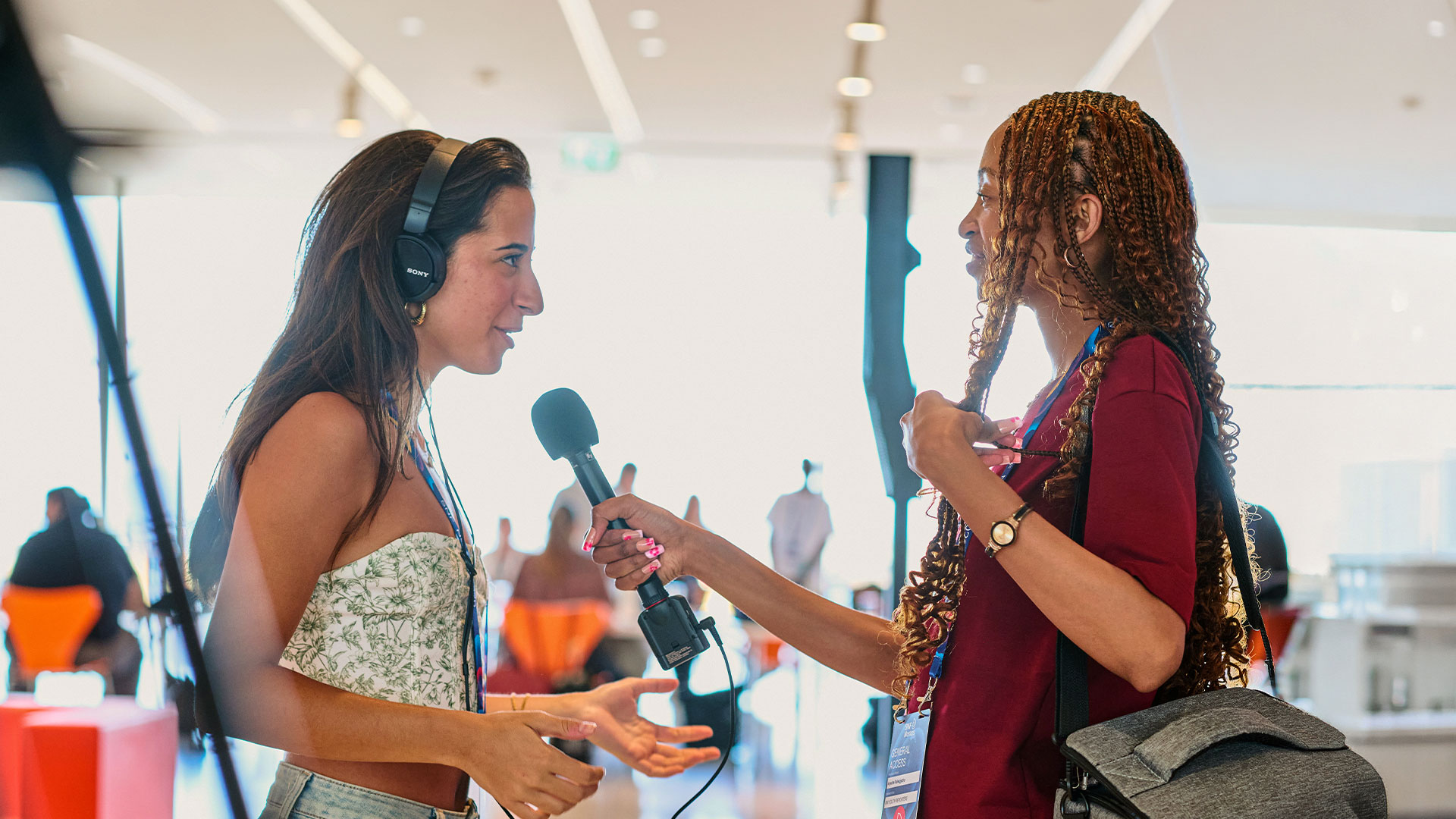
Radio Workshop’s Mike Rahfaldt sat down with iMEdD to discuss how critical it is for early career journalists to gain experiences out of the classroom and away from their screens. After a week of live radio shows and a series of video interviews during SNF Nostos 2026, youth reporters from South Africa, Greece, and Zambia agreed, and they shared how it feels to report out of your comfort zone.
Featured image: Youth reporters Petra Papapetrou (L) and Ayesha Ralekgetho (R) during a training activity at SNF Nostos 2026. Photo: Petros Toufexis/iMEdD.
Radio Workshop co-founder and executive producer Mike Rahfaldt was studying music and anthropology at the University of Michigan and deejaying at his college radio station when an oral history project on the 50th anniversary of the seminal Supreme Court case, Brown v. Board of Education changed his career trajectory.
“Some professor asked me if I would work with a group of high school students to do an oral history project with the local National Public Radio station. And I had no training. I had absolutely no skills,” he recalls. But he was immediately hooked. “It was such a revelation because I was able to see how young people, these high school students, had such fresh questions. They had such unique insights from where they stood. It just made me really think about how sometimes we don’t think enough about who’s asking the question.”
Audio proselytizers
Since then, Rahfaldt has devoted his life to training young people in audio journalism. Radio Workshop, which will mark its twentieth anniversary in 2027, collaborates with local radio stations in ten African countries to give university and high school students the opportunity to produce radio shows and podcasts, learn interviewing techniques and the basics of production and post-production.
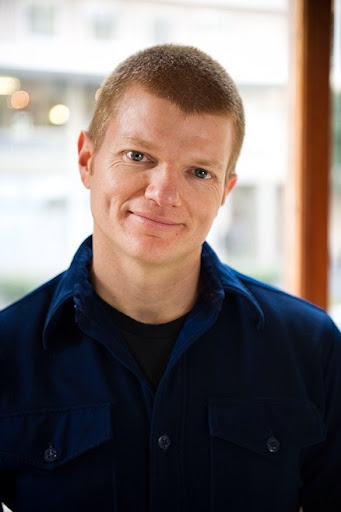
There’s so much desktop journalism happening. I feel like a lot of young people that we’re working with are terrified to actually talk to people. But once they’re in that position, they think journalism is this really alive thing that they would like to do.
Mike Rahfaldt, Radio Workshop co-founder and executive producer
“We’re very much audio proselytizers,” says Rahfaldt. He says the social, technical, writing and organizational skills gained by the youth reporters put them at an advantage over their peers.
“There’s so much desktop journalism happening,” says Rahfaldt. “You see someone, maybe under really tight pressure, trying to get a story together from a few press releases. You don’t even see the ‘color quote’ as much anymore. And I think that’s really sad. You need voices. You have to talk to people. I do feel like a lot of young people that we’re working with are terrified of that more and more – to actually talk to people, to actually approach people. But once they’re in that position where they have to do it, they feel liberated or really excited by it, or think journalism is this really alive thing that they would like to do, realizing what comes out of that human-to-human interaction.”
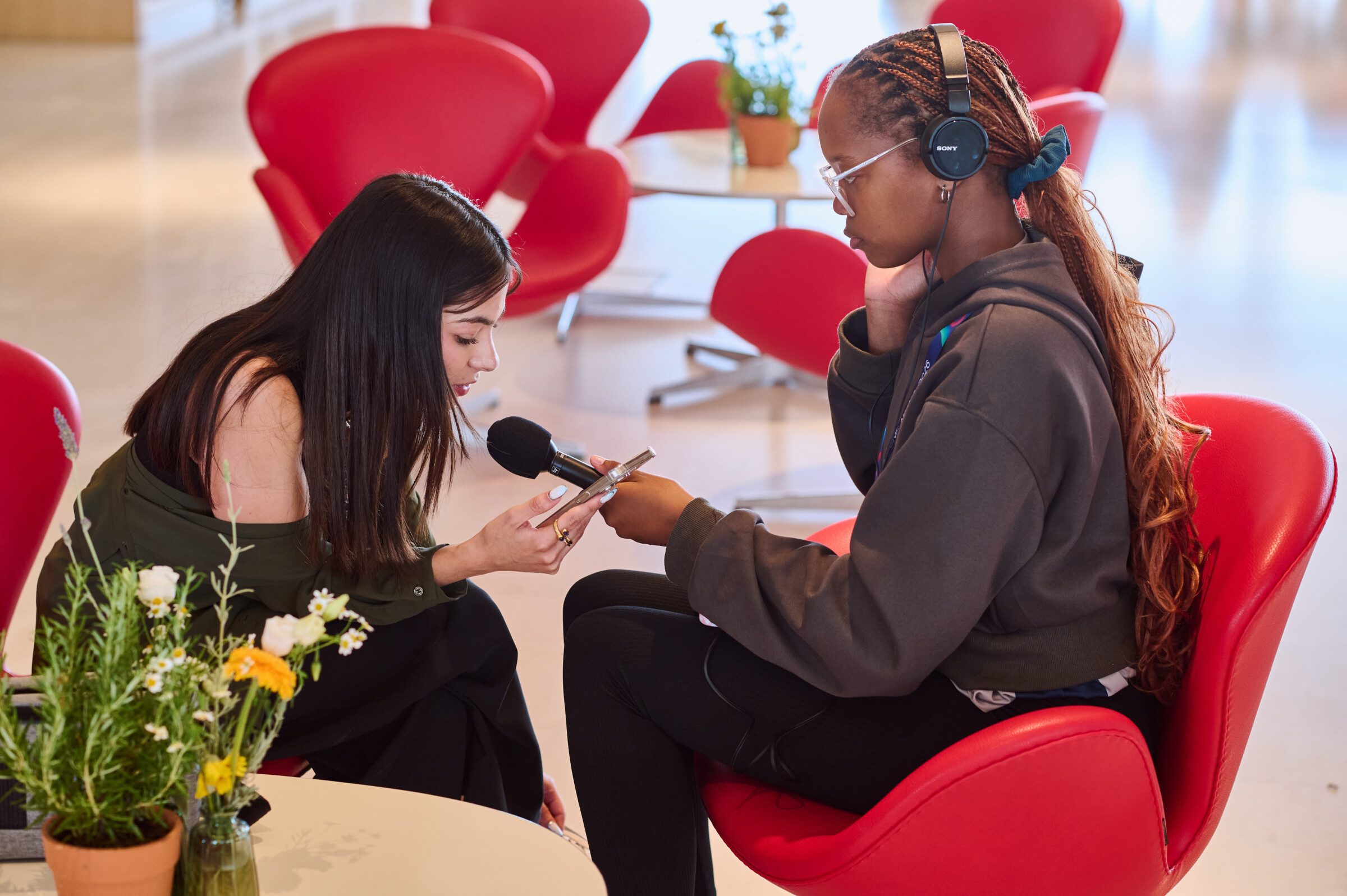
3, 2, 1, you’re on!
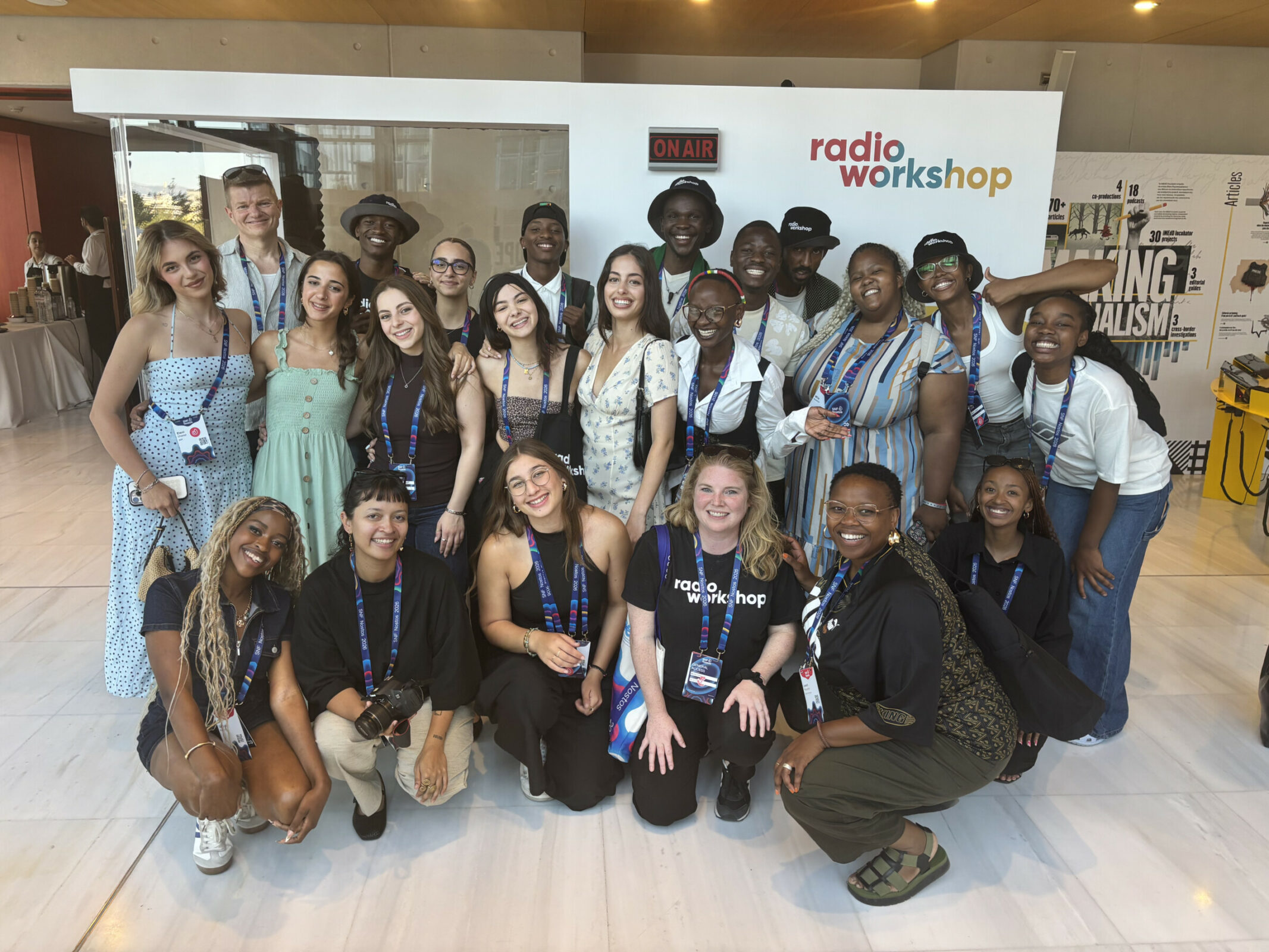
Recently, Radio Workshop, a grantee of the Stavros Niarchos Foundation, returned to Athens, Greece to take part in SNF Nostos 2026. Rahfaldt and several staff members brought twelve youth reporters, aged 19-28, from South Africa and Zambia to anchor a pop-up radio station. Ten journalism and communication students from four Greek universities joined them. All together, they broadcast live shows, thematically linked to SNF Nostos, over the course of the festival week. With iMEdD’s editorial team coordinating efforts and leading additional video productions, the 22 aspiring journalists also helped create a series of short video interviews with selected festival speakers.
Working in teams, the youth reporters had just three days to learn how to use the recording equipment, practice interviewing techniques, accost passers-by for vox pops, and write scripts before their first show.
“It’s always a bit terrifying to us because we are working with a group of journalists that we know to some degree, but we don’t totally know their ability to cope under pressure,” acknowledges Rahfaldt. “So doing three shows a day, hour-long shows, where there’s a lot of pre-packaged content, it’s a lot… Dealing with the muchness of it, the bigness of it, is part of that experience where it’s exhilarating. Three, two, one, and you’re on air. And let’s go and let’s see what happens. And I was just completely blown away by the youth reporters’ ability to do that.”
Vodcasts – from the golden age of narrative podcasts to the talk show gold rush

Today, well-coiffed podcasters – increasingly, celebrities – with gleaming smiles chat with their guests in set-designed studios. Funded by Big Tech, which has snapped up the formerly independent studios that used to produce podcasts, now most successful podcasts have some sort of video component.
Hands-on journalism for the first time
At the end of the week, all 22 youth reporters told Rahfaldt that the opportunity to interview so many “big and fancy” people was life-changing. Many said they had never been exposed to that kind of applied journalism.
Most of the interviews I had conducted up to that point had taken place either through a screen or online communication. Through a screen, the warmth of a genuine conversation is diminished, and with it, part of the very essence of the interview.
Evangelia Vergou, student at the Department of Communication and Media Studies, University of Athens
23-year-old Evangelia Vergou, an undergraduate student at the Department of Communication and Media Studies, University of Athens, told iMEdD in a written note that until SNF Nostos, she believed interviews needed to have a rigid structure and style.
“At Nostos, however, I learned that an interview doesn’t have to be confined to those conventions. My task was to truly get to know the people sitting across from me: to understand where they came from, how they thought, what was going on inside them, and, ultimately, why they were there at that particular moment,” says Vergou. At SNF Nostos 2026 she also experienced first-hand the intimacy of an in-person interview.
“Most of the interviews I had conducted up to that point had taken place either through a screen or via online communications. I noticed the difference in dynamics through two interviews with the same person. The first took place live, on air at the festival, while the second happened over a video call after they had returned to their home country. Through a screen, the warmth of a genuine conversation is diminished, and with it, part of the very essence of the interview. It’s a kind of distance we’ve grown accustomed to –one in which we feel safe. Yet, as comfortable as that safe distance may be, the connection between a journalist and an interviewee needs a sense of closeness in order to develop.”
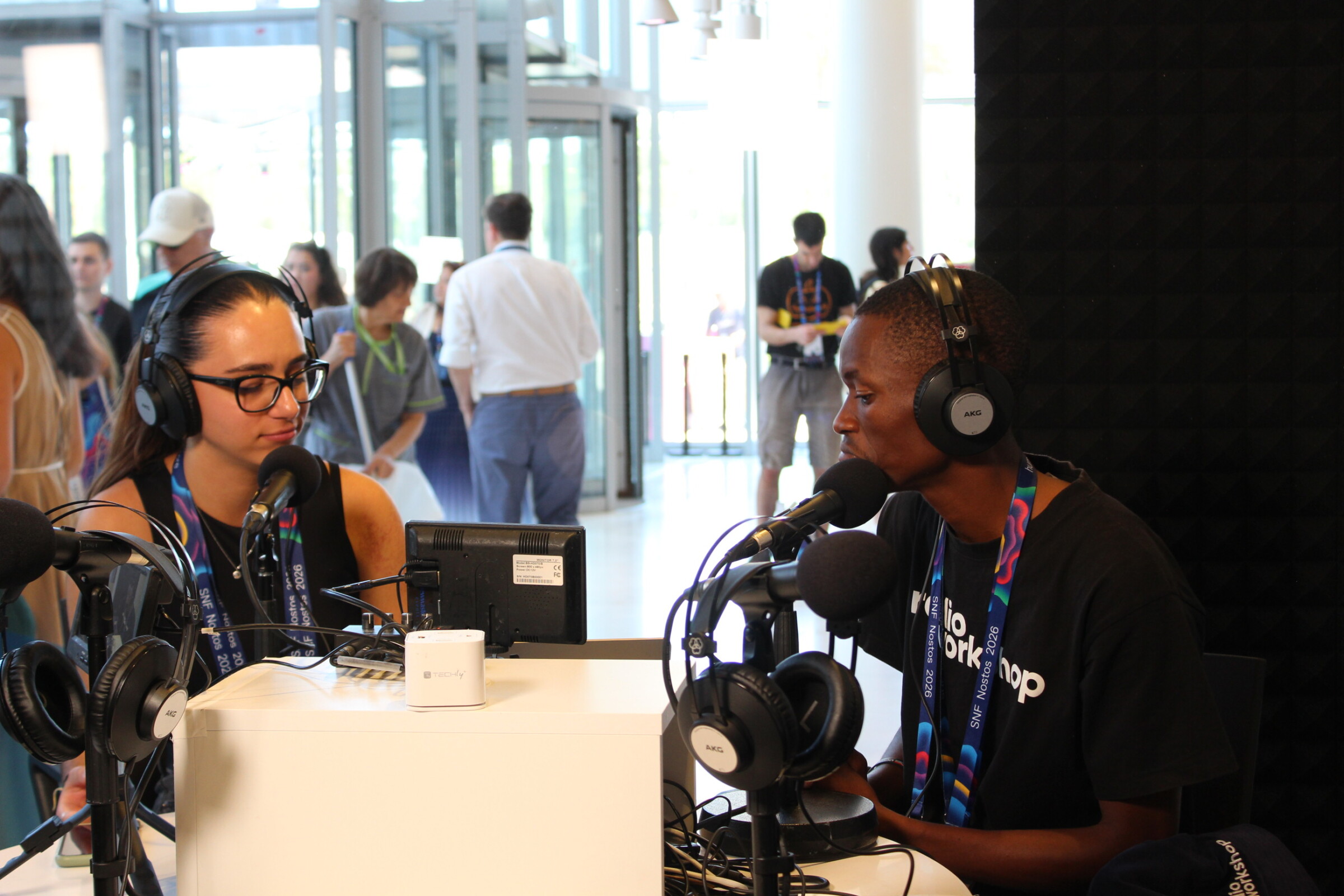
Gibson Zulu, a 28-year-old from Zambia studying at Cavendish University, said he was blown away by all the technical equipment he got to handle. He said he hopes to become adept at using the microphones, cameras, and editing programs used at SNF Nostos.
“Our universities do not really necessarily offer practical hands-on skills… it’s just theories, theories, theories, and there’s a chance when you get your degree, you go in the field and you might fail to do an interview,” Zulu says in a voice note sent for the purposes of this article.
Mila Madlingozi, a 23-year-old studying at South Africa’s Rhodes University, said in a voice note that being forced out of her comfort zone for a week made her a better journalist.
“SNF Nostos really challenged me to approach people I had never met before, ask meaningful questions, and adapt my interviewing style depending on the person. Yes, we learned this in the classroom but it really felt ‘real.’ It really pushed me out of my comfort zone and made me more confident as a journalist,” says Madlingozi.
Meanwhile, 22-year-old Petra Papapetrou, an undergraduate student attending Panteion University’s Department of Communication, Media and Culture, told iMEdD that “if it weren’t for this opportunity my path might have been completely different.” Her uncertainty stemmed from having had no prior hands-on journalism in a professional setting. The SNF Nostos experience, she wrote, “solidified my decision to pursue a career in journalism.”
The cost of learning remotely
Rahfaldt believes that partly to blame is the post-Covid normalization of remote work.
“A huge issue in a lot of universities that I interact with is that a lot of the departments have gone a lot more remote. So maybe the professors are working a couple of days a week on campus, and other days they’re home. And that’s lovely for them. But I think it’s terrible for students. Students need to be in the class, they need to be doing things. There needs to be a lot more interaction happening,” says Rahfaldt.
People need to know how to engage with human subjects. Journalists need to be in uncomfortable settings, asking uncomfortable questions –it’s how you evolve. If journalism schools are not facilitating that, I’m really worried about the future of journalism.
Mike Rahfaldt, Radio Workshop co-founder and executive producer
What worries him is that newsrooms and news leaders are more concerned with investing in the latest technologies rather than thinking about how to have more meaningful interactions.
“Everything I’m hearing about all the time is like, oh, how can we use AI in journalism? How can we use AI in newsrooms? And I understand the need to grapple with that. But people also need to know how to write. And they need to know how to engage with human subjects who have things to say. And I really worry that that’s falling by the wayside in some kind of journalism education that I’ve witnessed. Journalists just need to get out there. They need to talk to people. They need to be in uncomfortable settings, asking uncomfortable questions and just sort of dealing with that. It’s how you evolve as a journalist. And if journalism schools are not facilitating that, I’m really worried about the future of journalism.”
During SNF Nostos, 19-year-old Melina Theodosiou, an undergraduate student at Ionio University’s Department of Digital Media and Communications, was one of the youth reporters who travelled to Organi, a remote village in northern Greece. She said she felt awkward while interviewing community members and described to iMEdD how she powered through her discomfort in real time.
“At first, I felt like we were entering the residents’ personal space and I wondered whether they would feel comfortable speaking with us. I understood that it was not easy for them either, especially when some people did not speak Greek fluently and there was an additional barrier to communication,” writes Theodosiou. “However, as I began talking with them, that sense of awkwardness gradually disappeared. I tried to genuinely listen to what they were telling me and show real interest in their stories. That was when I understood that often the most important skill is not asking the ‘perfect’ question but creating a relationship of trust with the person sitting across from you.”