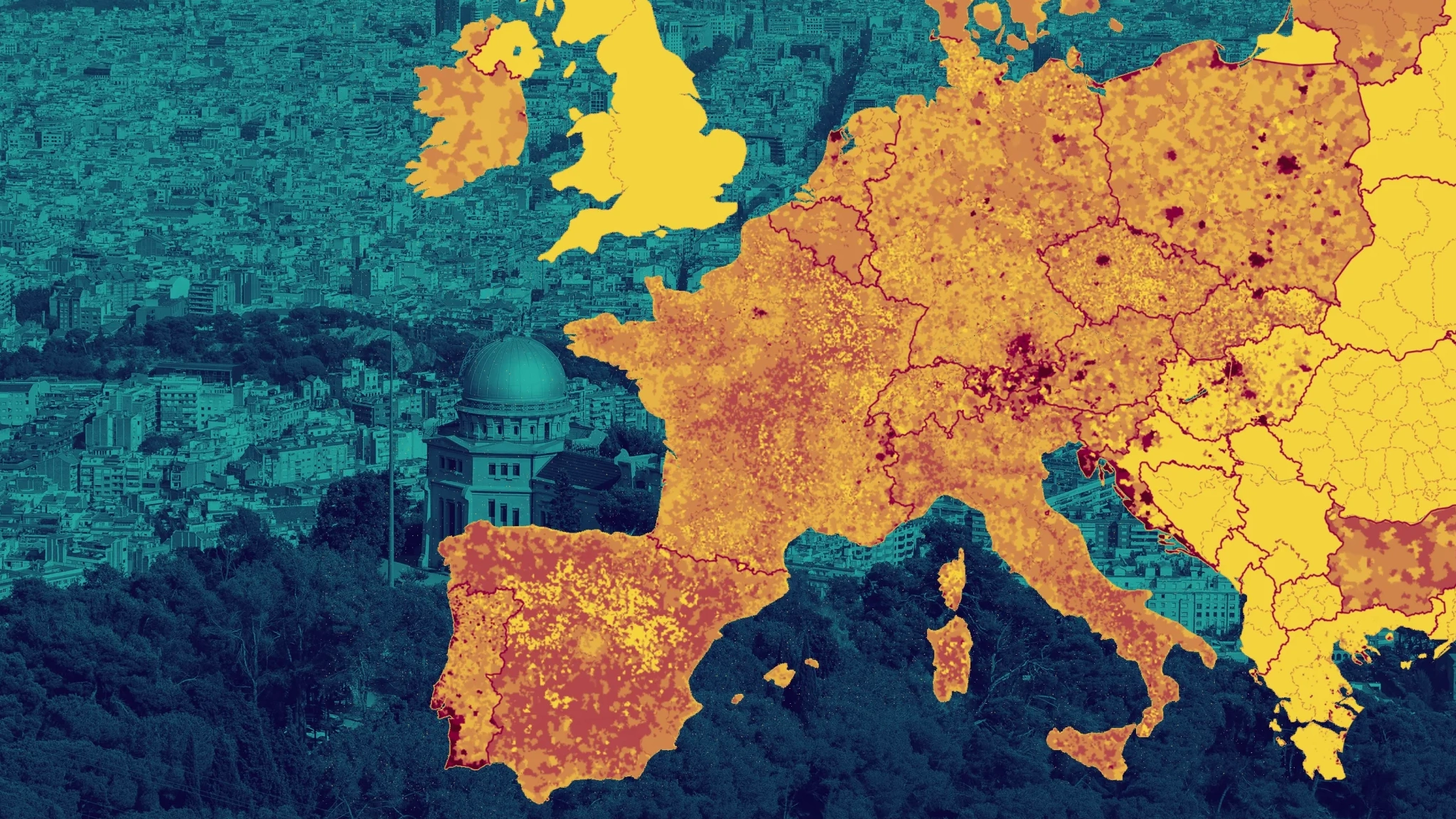
Across Europe, the housing crisis is no longer just a matter of rising prices. It is becoming a test of whether essential workers can still afford to live where they are needed. A recent analysis by CORRECTIV.Europe offers one of the clearest maps yet of where housing is becoming unaffordable and provides journalists a new tool to investigate the crisis locally.
Featured image: CORRECTIV.Europe
All eyes on earth: Strategies and tools for environmental stories
As climate change impacts communities worldwide, journalists who were present at the iMEdD International Journalism Forum 2025 shared strategies and tools to help turn attention to the planet’s most pressing issues.
Europe has become painfully expensive to live in. Renting is harder. Buying is worse. Surprising? Not really. According to Eurostat data, between 2015 and 2025, rents across the European Union, Norway, Iceland, and Switzerland increased by 21.1%. Home prices rose even faster, jumping as much as 63.6%.
A new analysis by CORRECTIV.Europe offers one of the first continent-wide views of local housing costs. The project features interactive maps of rent and home prices at the municipal level across the European Union, using data from the ESPON House4All dataset, an EU-funded research project that tracked average rents and home prices – as scraped from 100 million online property listings – across nearly 100,000 cities and municipalities in Europe between March 2024 and March 2025. It goes, however, a step further by comparing housing costs to the salaries of a single profession – nurses – revealing which cities are truly affordable to them.
The visualization and dataset are open to journalists who sign up through CORRECTIV.Europe’s website, providing a powerful tool to explore housing pressures across Europe.
Rents in the EU, Norway, Iceland, and Switzerland rose by 21.1% between 2015 and 2025, according to Eurostat data. During the same period, the increase in real estate prices reached 63.6%.
A dataset across 100,000 European cities
CORRECTIV.Europe is a cross-border investigative journalism network linking more than 450 European media and journalists across Europe. It has long focused on stories that are both local and pan-European in scope, often pairing reporting with cross-border data.
By 2024, the housing crisis stood out as an obvious topic to the team, said Frida Thurm, senior reporter at CORRECTIV.Europe, speaking to iMEdD from Berlin. “We always aim at topics that connect to almost everybody in Europe,” she added, explaining that housing is usually the biggest expense for European households.
While digging into the issue, Thurm discovered the ESPON House4All dataset. The ESPON researchers collected the data weekly for a year across all EU and EFTA countries. The dataset has limitations, though. Especially for countries in the Balkans where the data was not available. Dc d
There have been similar datasets in the past, created by data journalists, but on a much smaller scale, said data journalist, Luc Martinon, who collaborated with Thurm on the project until the end of 2025. “I was happy to see that it was a proper scientific team that had taken all the necessary precautions,” he said.
Two simple benchmarks: one nurse, a 45-square-meter home
The team at CORRECTIV.Europe saw the housing crisis clearly: when essential workers can no longer afford housing, the problem extends far beyond them. It begins to affect entire communities.
Nurses offered a useful benchmark, said both Thurm and Martinon.
In most European countries, their salaries sit close to the national average, sometimes slightly below, sometimes slightly above. To determine affordability, the team collected national and regional averages for nurses’ salaries, reaching out to each country’s statistical office. They also relied on an OECD dataset where national data was unavailable. Using the general average income for a country would have made the analysis feel anonymous. Focusing on a professional group that people can relate to makes the issue easier to understand and follow.
Using the general average income for a country would have made the analysis feel anonymous. Focusing on a professional group that people can relate to makes the issue easier to understand and follow.
Then, to keep the calculations consistent, the team also assumed a single-person household. The ESPON dataset groups apartments into four sizes: 25, 45, 75, and 100 square meters. The team focused on the 45-square-meter category. It is close to the average living space per person in the European Union. Small, but realistic for a one-person home.
The CORRECTIV.Europe model simplifies real life, said Martinon. Many households rely on two incomes or include children. But the exercise still reveals where the strain is greatest under the common rule that housing should not exceed 30 percent of net income. This threshold is widely regarded by Harvard University researchers as a reliable measure of affordability.
By combining these data points, the team mapped the housing crisis, highlighting municipalities based on nurses’ affordability. Areas where rent consumes less than 20% of a nurse’s salary are shown in green, 20–30% in orange, and 30% or more in red.
CORRECTIV.Europe’s analysis found that eight of the ten largest cities in the EU and EFTA—including Berlin, Rome, Paris, and Vienna—are already out of reach for nurses. The toughest rental markets for nurses are in Croatia, Portugal, Ireland, Latvia, and Iceland. Greece also made the list of the ten least affordable countries to buy a house.
Eight of the ten largest cities in Europe—including Berlin, Rome, Paris, and Vienna—are already unaffordable for nurses. Rents are also high in Croatia, Portugal, Ireland, Latvia, and Iceland. Greece is also among the ten most unaffordable countries for buying property.
Thurm noted that the housing pressure may not yet be fully visible.
“It may not be an immediate issue if many nurses are still on older rental contracts, since the data reflects listed prices for new rentals and sales. But even if enough nurses live there now, the data clearly suggests this will become a problem in the future.”
Green to Gray: The data, the mountains, and the politics of land
Europe is building at a relentless pace. Logistics hubs rise on former farmland. Wind turbines pierce mountain ridgelines. Industrial zones replace wetlands. What was once green is turning grey.
What journalists can do with the data
Frida Thurm highlighted that she and her colleagues focused on identifying an angle that would be both interesting and relevant, not only for their own audience at CORRECTIV.Europe, but above all for the audiences of their local network partners. In September 2025, speaking directly with reporters from local and regional media at the iMEdD International Journalism Forum 2025 “has proved especially valuable, offering firsthand insight into local realities and needs,” she noted.
The reporting recipe grew out of CORRECTIV.Europe’s research and feedback from its local partners. “One piece of feedback that stood out was the need to clarify the limitations of the data in the methodology section. Every dataset has its constraints,” said Thurm.
The recipe is designed to help journalists navigate the spreadsheets and maps to pinpoint costly municipalities, evaluate housing affordability for essential workers, and compare local markets with national trends.
The project also offers story ideas, from exploring housing policies and talking to residents like nurses or students, to analyzing local factors driving price hikes, such as short-term rentals or empty homes.
Overall, the dataset offers a fresh way to see Europe’s housing crisis unfold, not just nationally, but down to individual streets and cities.
Turning data into impactful stories
The interactive map was designed to be fully explorative, letting users zoom in, search for cities, and view local data. To ensure fast loading, map colors were pre-calculated, with additional data appearing in info panels, said Martinon. The map now defaults to English and German, but users can embed it in an iframe and select their preferred language.
Reporters who want to integrate the map to their website should first request permission from CORRECTIV.Europe.
Then, the map can easily be embedded on a webpage using an iframe, for example:
The name property of the iframe map_mode#language#zoom/center_lat/center_lon can be used to personalize the map to zoom at a certain location, and to include parameters such as sales rental prices, nurses data, with sales prices selected and nurses data, with rental prices selected.
For example, we created a map in English that zooms in Italy with nurses’ data, with rental prices selected.
The result of this process is very simple and very blunt,” said Thurm. “In urban centers, in the big cities, it’s unaffordable for nurses to live, which is going to create a problem.” She added that another key insight, emphasized by the ESPON scientists, is that touristic areas are major hotspots for unaffordability.
CORRECTIV.Europe’s partners have used the data to produce numerous impactful stories. “I really like what the team of Le Parisien did. They also made it searchable, like a small database of the Paris surrounding municipalities. You could search for the name. That was very nice, and I think a very user-friendly approach to working with the data,” said Thurm.
She also shared a surprising outcome from feedback: “I posted it on LinkedIn with a picture of the map, and it got over 100,000 impressions, which I did not expect. And that was even just in German.”