
As Georgia has dropped to 135th place in the 2026 World Press Freedom Index amid unprecedented hostility towards journalists, iMEdD spoke with representatives of four independent media outlets about the challenges facing journalism in the country: imprisonments, attacks, “foreign agent” laws, and the struggle for survival.
Featured image: Evgenios Kalofolias
RSF Index 2026: Press freedom worldwide hits record low
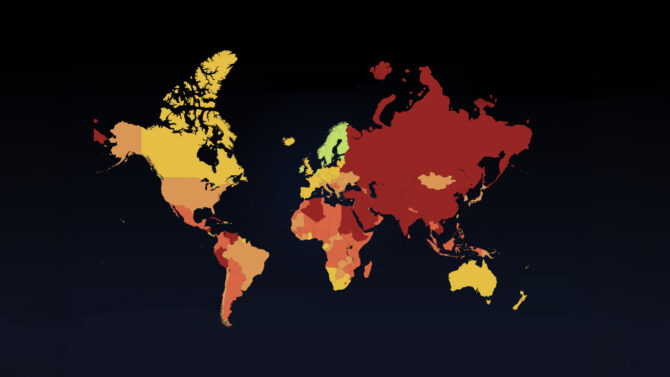
Press freedom is at its lowest level in 25 years worldwide, according to Reporters Without Borders’ 2026 World Press Freedom Index.
“Ι cannot remember any other period in Georgia’s recent history, since I’ve started as a journalist in 1997, with such a harsh and hostile environment towards journalists, media workers and civil society.” That is how Tamar Rukhadze, Deputy Director of Georgian outlets Batumelebi and Netgazeti, describes Georgia’s state of the press, in an interview with iMEdD, calling today’s situation the “worst” she has seen in her career.
Rukhadze’s alarming comments are starkly illustrated in this year’s World Press Freedom Index, published by Reporters Without Borders (RSF), in which Georgia ranks 135th out of 180 countries, having fallen 21 places since 2025. Georgia’s government, led by the Georgian Dream party, has intensified its crackdown on media in recent years – especially since 2023 – adopting a series of restrictive laws with the goal of suppressing the country’s independent media. Meanwhile, Georgian journalists have been facing constant threats, from legal challenges and economic harassment to smear campaigns and physical attacks.
Ι cannot remember any other period in Georgia’s recent history, since I’ve started as a journalist in 1997, with such a harsh and hostile environment towards journalists, media workers and civil society.
Tamar Rukhadze, Deputy Director of Batumelebi and Netgazeti
Georgia’s deteriorating press freedom situation is part of a broader process of democratic backsliding unfolding in the country, which has also seen the right to peaceful protests severely restricted, opposition politicians jailed, a decline in judicial independence and a disputed election in October 2024.
Although Georgia has been an EU candidate country since 2023, the ruling Georgian Dream Party, founded by oligarch Bidzina Ivanishvili, has in recent years pivoted the country’s foreign policy towards Russia. Large segments of Georgia’s population remain fiercely pro-EU, however, and the country has been experiencing more than 500 consecutive days of protests since November 2024, following the contested October 2024 elections and the government’s decision to suspend efforts to advance Georgia’s EU accession process until 2028.
As the struggles of Georgia’s independent journalists have intensified in this increasingly repressive political and legal environment, so too has their determination to survive.
CEO behind bars, her colleagues press on
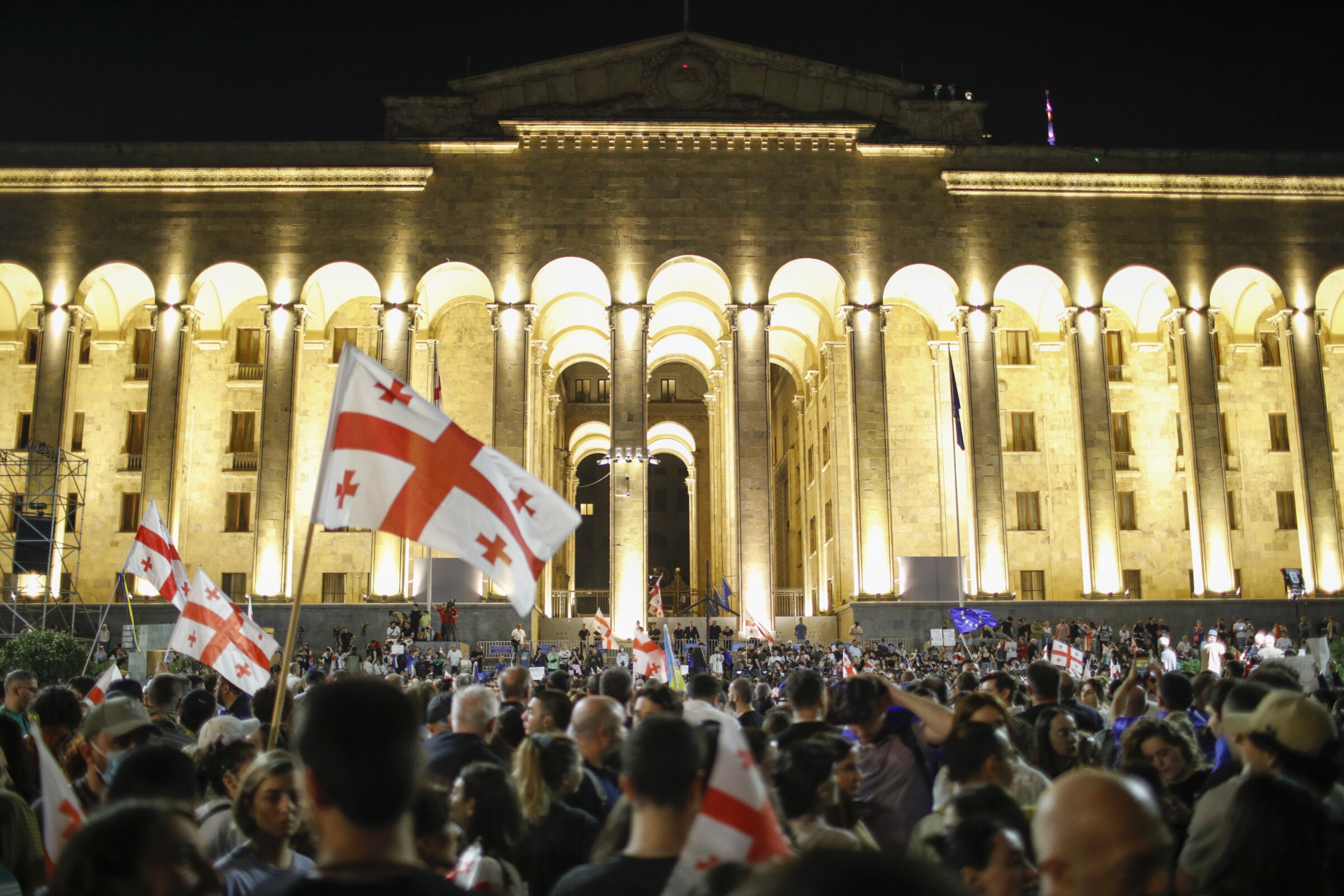
Batumelebi and Netgazeti have paid a heavy price for their independence. The outlets’ co-founder and CEO, Mzia Amaglobeli, was arrested on January 12, 2025 after an altercation with a police chief in Batumi, Georgia’s second largest city. Following a trial which press freedom groups denounced as politically motivated, describing the charges attributed to her as disproportionate, Amaglobeli has been sentenced to two years in prison. Meanwhile, in December 2025, she was awarded the European Parliament’s Sakharov Prize for Freedom of Thought. She remains detained under deplorable conditions. Her eyesight – already poor before her imprisonment —is now almost completely lost, Rukhadze tells us, while her lawyers spent six months securing permission for her to visit a clinic of her choice, as medical facilities within the penitentiary system lack proper equipment, she adds.
“We aren’t the same as we were earlier before this imprisonment,” Rukhadze tells iMEdD, stressing the deep psychological effects Amaglobeli’s sentence has had on the newsrooms: “it’s a nightmare for every single journalist to become news.” Even reporting on her case is difficult, as it’s almost impossible for Batumelebi’s and Netgazeti’s reporters to distinguish themselves from Amaglobeli. “It’s almost reporting on yourself,” she continues.
We aren’t the same as we were earlier before this imprisonment […] it’s a nightmare for every single journalist to become news.”
Tamar Rukhadze, Deputy Director of Batumelebi and Netgazeti
At the same time, Amaglobeli’s imprisonment has motivated her colleagues not to give up, Rukhadze stresses. Rather than resorting to self-censorship, Batumelebi’s and Netgazeti’s journalists have persisted in their reporting: “The first thing Mzia did after her arrest was to send a message from prison, asking her team to continue their work as before —to do what they had always done and what they are known for: professional, ethical watchdog journalism that gives a voice to those who need it most,” she highlights.
“Foreign agent” laws and SLAPPs, the legal challenges faced by journalists

Which are the new dangers that threaten the freedom of the press, and how can journalists continue to operate safely under conditions that are becoming increasingly difficult?
Weaponizing the law
Arrests and detainments are only one of the ways in which the Georgian government uses legislation against the country’s independent media. Nino Bakradze, co-founder and editor-in-chief of the investigative media outlet iFact, tells iMEdD they have lost 90% of their income since May 2025 owing to a series of laws that have restricted the outlet’s access to foreign funding, once its main source of revenue.
Georgian media, civil society organizations and individuals receiving financial support from abroad are obligated to register as foreign agents under the 2025 Foreign Agents Registration Act (FARA) and face criminal liability for noncompliance. When such provisions are combined with the 2025 amendments to the law on grants, which require foreign donors to obtain governmental approval before offering grants to Georgian recipients, the causes for iFact’s financial troubles become clear.
Because foreign grants had been a major source of funding for Georgia’s online media for years, as Rukhadze explains, iFact’s financial situation is far from unique. Batumelebi and Netgazeti are also struggling financially: “We are trying to find ways to survive because it’s not about development, it’s not about a bright future or expansion or professional growth or anything. It’s about just survival,” she stresses. For Sulkhan Meskhidze, founder and journalist of the regional outlet Adjara Times, these laws have denied him the possibility to further develop his newsroom, which was founded in December 2023, he tells iMEdD. As of today, he remains the only employee of the outlet relying on publishing advertisements for local businesses as his sole source of income.
It’s not about development, it’s not about a bright future or expansion or professional growth or anything. It’s about just survival.
Tamar Rukhadze, Deputy Director of Batumelebi and Netgazeti
In March 2026, access to foreign funding was further restricted, when the Georgian parliament adopted new amendments to the law on grants, expanding the definition of a “grant”. These amendments represent the latest development in a process which began in 2023, with the Georgian Dream government trying to adopt legislation requiring media and civil society organizations who receive over 20% of their funding from abroad to register as “foreign agents”. Although mass protests prevented its immediate adoption, the “Law on Transparency of Foreign Influence” —commonly known as the “Russian law” due to its perceived similarity to Russia’s “foreign agent” law—, was passed in May 2024. Batumelebi and Netgazeti have refused to register as foreign agents, Rukhadze tells us, as have most Georgian independent media.
Amid such restricted legal and political circumstances, the trust between sources and journalists has been disrupted, Bakradze says. Georgians are now often reluctant to talk to iFact’s journalists and request to speak under anonymity in fear of potential consequences. There have indeed been cases of people who have lost their jobs or access to social aid after openly criticizing the government, Bakradze adds. Lack of access to public information — due to government restrictions — has emerged as another major challenge for the investigative outlet, having slowed down its reporting. iFact now increasingly relies on using international databases to access information instead, Bakradze tells iMEdD.
Attacks, smear campaigns and surveillance
Reporting is becoming increasingly dangerous for Georgia’s journalists. Since 2023, 65 cases of physical assault and 83 verbal attacks against Georgian reporters have been recorded, according to the European Centre for Press and Media Freedom’s (ECPMF) Mapping Media Freedom Platform.
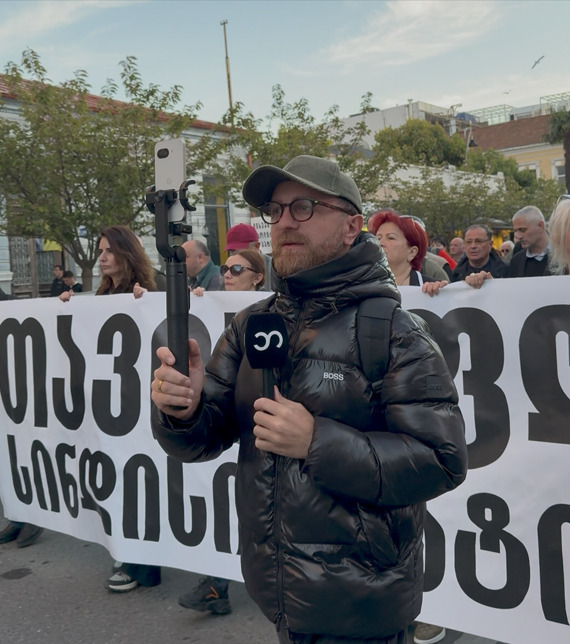
Sulkhan Meskhidze, who started working as a journalist in 2010, is no stranger to physical and verbal harassment. Such incidents have intensified in the last five years, he tells iMEdD, highlighting that in almost every other on the field reporting assignment he becomes the target of attacks. In one of the most recent ones, on May 7, 2026, Meskhidze tells us that he was attacked by individuals working in Batumi’s Khelvachauri Municipality City Hall while trying to perform his professional duties. One of them even tried to remove and break his microphone, continues.
The most serious attack Meskhidze faced came in February 2025, while he was reporting on the deaths of two kids at a public construction site, in an area of Batumi called “Dream City.” As he investigated who might bear responsibility for the tragedy, a group of people began throwing stones at him and demanding that he leave. According to Meskhidze, the aggressors were local residents and supporters of the government.
In both incidents, the police were present, Meskhidze says, but did nothing to protect him. Even when —in other cases— he had managed to record and publish evidence of such attacks, authorities still remained indifferent. “I’m essentially unprotected,” he stresses.
iFact has recently experienced a different type of attack, in the form of smear campaigns. As Bakradze recounts, after the outlet published an investigation regarding how Russian oil continues to move through Georgian ports despite international sanctions, the European Commission decided to put Georgia’s Kulevi port on a potential sanctions list. Following that, in March 2026 pro-government media “labeled us as spies of the British intelligence service because the British government is very active in terms of sanctioning,” Bakradze explains.
This was only one of the two smear campaigns iFact experienced in that month, with pro-government media also attacking them in response to an investigation on the assets of Georgia’s Minister of Internal Affairs. Counterintuitively, these smear campaigns have helped iFact by raising awareness around the outlet’s work, Bakradze notes. On the other hand, while “it’s not very stressful for us personally because it has become kind of normal”, she adds that “it’s still very stressful for our family members.”
Physical and digital surveillance presents another major challenge for iFact. “A lot of time we see the state security people around us, so that has also become kind of a normal and we are more afraid when they don’t appear,” Bakradze says. Their phones are also being surveilled, she continues, while cyberattacks are common, but iFact’s digital security protocols are so far able to resist.
A lot of time we see the state security people around us, so that has also become kind of a normal and we are more afraid when they don’t appear.
Nino Bakradze, co-founder and editor-in-chief of iFact
Survival tactics: From wine tasting to yoga
Bakradze, who co-founded iFact in 2016, tells iMEdD she would not have decided to establish an outlet today. “When you start the week on Monday, you never know if you’ll last until Friday or not,” she notes. What keeps her going? The support and trust of their supporters, she tells us, and iFact’s mission to deliver the truth to “a society which desperately needs it right now.”
Since losing their foreign grants related revenue, iFact is now relying entitely on local Georgian derived income, Bakradze explains, selling a monthly newsletter on sanctions evasion, while also offering a paid membership, the first outlet in Georgia to do so, she says. Events form another source of revenue, with iFact organizing a wine tasting event in May 2026.
What has helped iFact’s reporters cope with stress is making themselves busy and seeing the results of their investigations Bakradze says, adding that “we do yoga as a team.” Sulkhan Meskhidze, who also experiences anxiety and occasionally visits a psychologist, worries mostly about the stress his family is facing, who live in constant fear for his wellbeing and often urge him to tone down his reporting. Meskhidze intends to continue his work normally, however, as he tells iMEdD, because of the responsibility he feels towards Georgian society.
“Lights must stay on”
Georgia’s independent media have also forged a collective response in the form of Sinatle Media a solidarity and sustainability network of 22 online media. As Sinatle’s Chair of the Board and journalist at the investigative outlet Studio Monitor, Teo Kavtaradze tells iMEdD, the need for a united front became increasingly urgent in April 2025, after the law requiring government approval to obtain foreign grants was adopted. Following a lengthy bureaucratic process, Sinatle Media was born in July 2025. The Georgian journalists who spoke to iMEdD all work for media outlets that belong in the network.
In Georgian, Sinatle means “light,” a name that reflects the link between independent journalism and the truth. Both the name and the network’s slogan, “Lights Must Stay On,” were chosen to underscore a shared conviction: “If the lights go out, the truth disappears with them,” Kavtaradze highlights.
In Georgian, Sinatle means “light,” a name that reflects the link between independent journalism and the truth
One of Sinatle Media’s main functions involves collecting funds which are then allocated to its 22 members, according to their size and needs, Kavtaradze explains. Through a series of events, including bookfairs, flea markets and artwork auctions, Sinatle has managed to raise 260,000 GEL (approximately €84,000).
The network supports its members’ organizational development while also providing cost-sharing services, which proved particularly valuable in December 2025 during a smear campaign against the network. Sinatle Media helped its members secure legal support to counter these allegations, assistance they could not have afforded on their own.
This is the first case when we [Georgian media] are actually helping each other and we are building this solidarity together.
Teo Kavtaradze, Sinatle Media’s Chair of the Board
One of Sinatle’s main achievements, according to Kavtaradze, is that this is “the first case when we [Georgian media] are actually helping each other […] and we are building this solidarity together.” Her comments are echoed by Bakradze: “more valuable and more important for me than money is the solidarity and unity of the Georgian online media and the readiness to help each other.” For Rukhadze, Sinatle Media is a “very unique example of unity and solidarity we have not seen in this country before.”