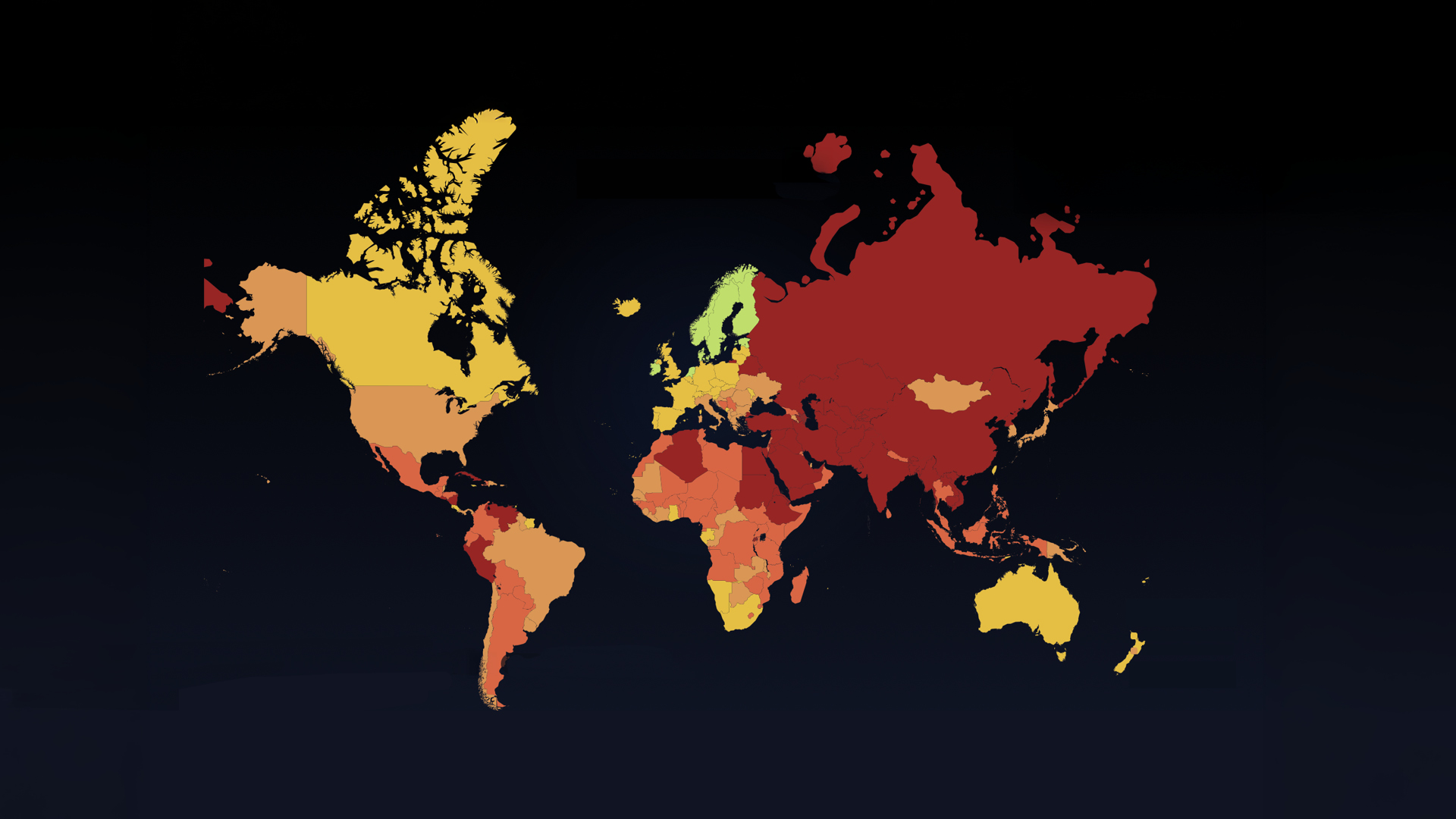
Press freedom is at its lowest level in 25 years worldwide, according to Reporters Without Borders’ 2026 World Press Freedom Index. The average country score has fallen to a record low, and more than half of all countries are now classified as being in a “difficult” or “very serious” situation.
Featured image: RSF, Evgenios Kalofolias
Sudan, the black hole of journalism
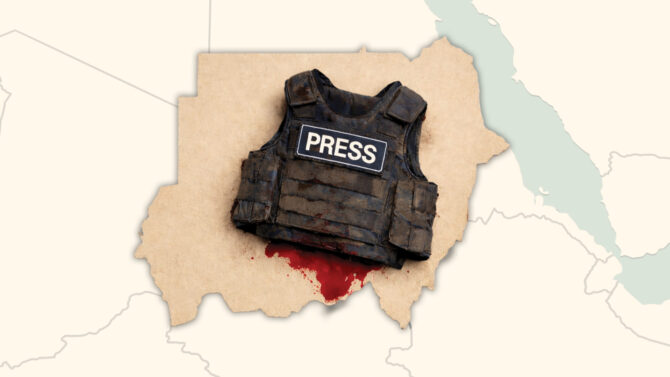
Sudanese journalists who have been forced to flee the country, international reporters, researchers, and experts speak to iMEdD about the challenges of covering the civil war, explaining how, beyond the cities themselves, even information is under siege.
Press freedom around the world has reached a 25-year low in 2026, according to the 2026 World Press Freedom Index, published by Reporters Without Borders (RSF) on April 30.
The Index ranks every country or territory in a list, from the country with the greatest press freedom to the one with the most repressive environment for journalism. Each country’s overall score in the Index is calculated based on its performance across five indicators: the political, legal, economic, and sociocultural context, as well as the general safety of journalists.
This year’s report notes that the average score of the 180 countries examined is at its lowest level since 2001.
The sharpest decline was recorded in the legal indicator’s score, “a clear indication that journalism is increasingly being criminalized worldwide,” according to RSF.
Between 2025 and 2026, the legal indicator, which assesses the legal framework ensuring the safe and free practice of journalism, deteriorated in 60% of the countries surveyed. It is noted, in fact, that the expansion of restrictive legal frameworks has “gained ground” even in democratic countries, often accompanied by abusive enforcement of legislation against journalists, particularly in the context of counterterrorism efforts.
Reporting when the internet goes dark
Journalists worldwide navigate internet shutdowns, using risky workarounds to report news, exposing censorship, infrastructure failures, and personal, professional costs.
A decline in press freedom worldwide
The state of press freedom in half of the countries (52.2%) included in the Index now falls into the categories of “difficult” and “very serious,” with the global map turning increasingly red over time, as at the launch of the Index in 2002, these two categories constituted a minority (13.7%). At the same time, the percentage of the global population living in countries where press freedom is rated as “good” has dropped dramatically from 20% in 2002 to less than 1% in 2026.
Authoritarian states, complicit or incompetent political powers, predatory economic actors, and under-regulated online platforms are directly and overwhelmingly responsible for the global decline in press freedom.
Anne Bocandé, RSF Editorial Director
“Although attacks on the right to information are more diverse and sophisticated, their perpetrators are now operating in plain sight. Authoritarian states, complicit or incompetent political powers, predatory economic actors, and under-regulated online platforms are directly and overwhelmingly responsible for the global decline in press freedom,” mentioned Anne Bocandé, RSF Editorial Director. “Given this context, inaction is a form of endorsement.”
The percentage of the global population living in countries where press freedom is rated “good” has dropped dramatically from 20% in 2002 to less than 1% in 2026.
The countries where there is the most and the least press freedom
For the 10th consecutive year, Norway topped the ranking, a position it has held 16 times since 2002, followed by the Netherlands and Estonia. At the other end of the list, Eritrea ranked last for the third consecutive year, recording its lowest score in the last five years. The African country is followed by North Korea and China, while Iran ranks fourth from the bottom.
The United States also saw its position decline in 2026 compared to 2025, dropping seven places to 64th, following what RSF describes as the U.S. president’s systemic attacks on the media.
Greece: Rise in the Index, but still ranks last in the EU – Pressure from wiretapping and SLAPPs
In 2026, Greece moved up from 89th to 86th place globally in the Press Freedom Index, but since 2022 it has remained the lowest-ranked country among European Union member states. Just above Greece in the rankings are Cyprus (80th place), Hungary (74th place), and Bulgaria (71st place).
RSF note that press freedom in Greece has been grappling with a “systemic crisis since 2021,” noting that the wiretapping scandal involving the National Intelligence Service (EYP) and the 2021 murder of journalist Giorgos Karaivaz remain unresolved. At the same time, journalists in Greece frequently face SLAPP lawsuits (strategic lawsuits against public participation).