Journalists from the Outlaw Ocean Project investigated the aquaculture supply chain and mapped it on a publicly accessible platform so journalists and researchers could scrutinize how the industry works.
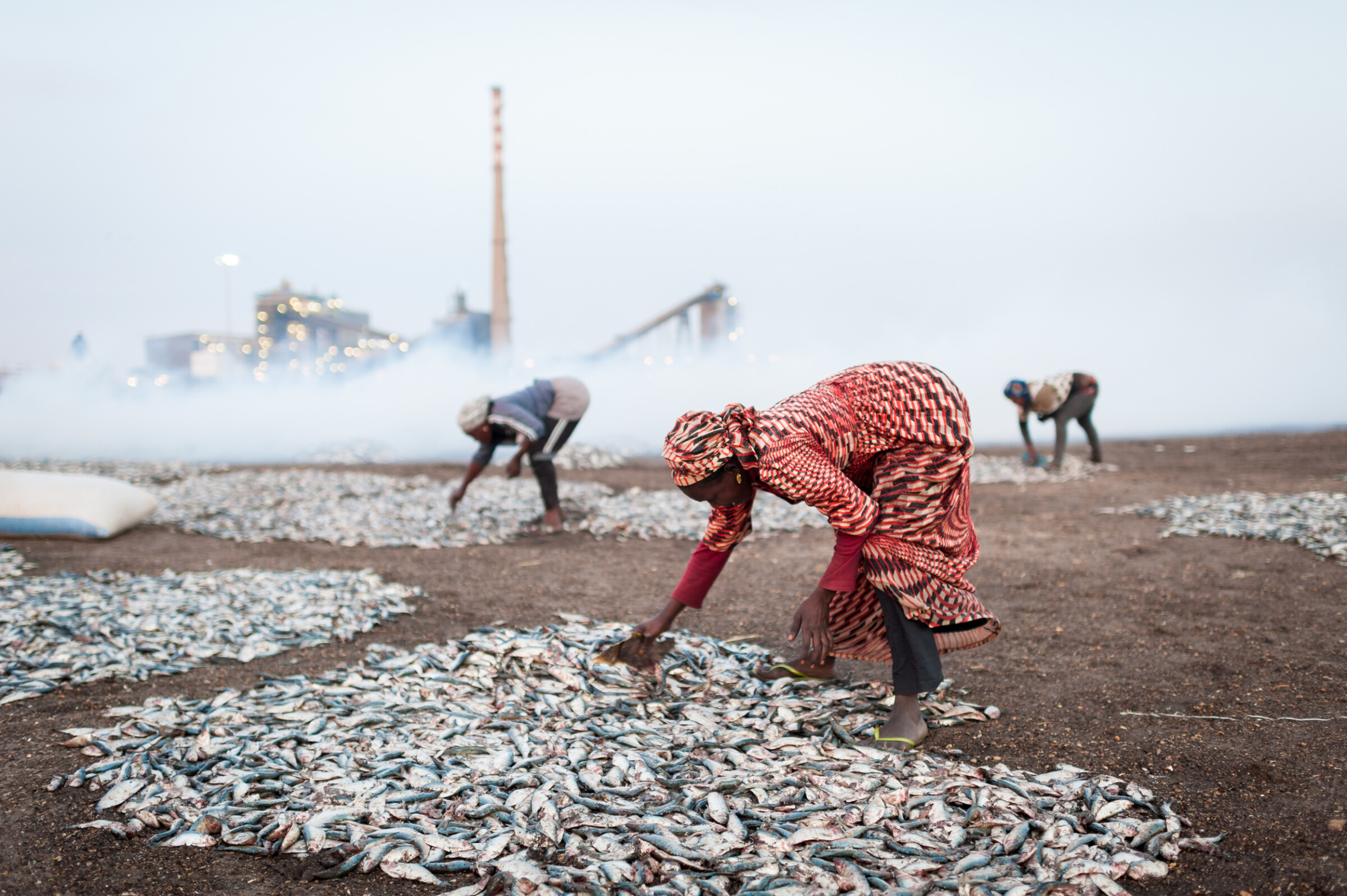
Featured Image: A worker tosses fishmeal pellets into pens at a fish farm in Thailand in 2021. Over half of the seafood eaten worldwide comes from fish farms. Photo: Mako Kurokawa. Courtesy of Outlaw Ocean Project
Translation: Anatoli Stavroulopoulou
In early October 2026, news outlets around the world turned their attention to fish farming in their own countries, raising a question about the fish that end up on our plates: what are they fed?
This sudden interest is no coincidence. It is the result of a five-year investigation coordinated by the Outlaw Ocean Project, a non-profit journalism organization founded and directed by investigative journalist Ian Urbina, who focuses on crimes committed at sea. The five-year investigation, Food for Feed, combined reporting from six field missions with an analysis of tens of thousands of documents. The team compiled its findings in an online tool called Bait to Plate, where journalists, researchers and members of the public can unravel the tangle of the seafood industry.
FireWatch: The public contracts for fire prevention and wildfires data, all in one app

An application developed by data journalist Thanasis Troboukis visualizes public contracts of the central government and local authorities in Greece, as well as the data behind wildfires.
On the high seas
In 2015, Urbina completed the first part of “The Outlaw Ocean,” his multimedia investigation into crimes committed in international waters. It exposed everything from arms smuggling and illegal fishing to waste dumping and human trafficking aboard fishing vessels.
Susan Ryan, is the Operations and Investigations Editor at the Outlaw Ocean Project, the newsroom set up after the success of the original investigation. She tells iMEdD that fish farming and fish feed kept coming up in Urbina’s investigation. «At first, we found it hard to get into as a story, because simply describing what [the seafood supply chain] is isn’t news. […] Ian came up with this concept of looking at it in great depth, and we ended up with this quite massive project. The point was to try to examine every link in the chain, from the raw material for fish meal food coming out of the sea and the fish that comes out of the ocean, all the way to how that ends up being fed to other fish in fish farms, and finally how that fish ends up on human plates.”
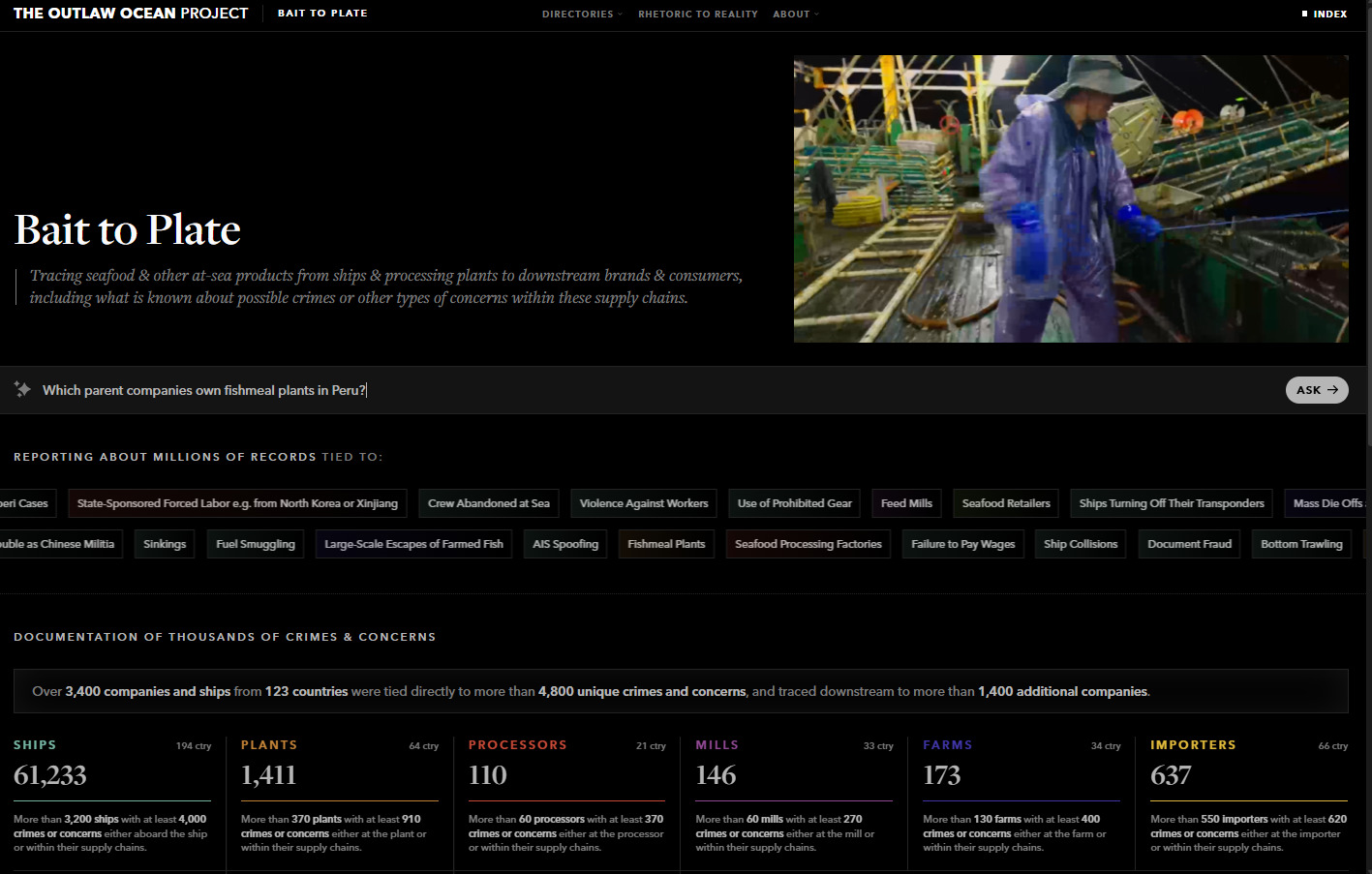
The Bait to Plate platform
The platform built by the Outlaw Ocean Project journalists works as an information repository. Following the different stages of fish farming, it presents data on the entire production chain, from fish farms and fishing vessels to supermarket product brands. Susan says it’s important that users can see how all this information connects.
The database groups the entities it tracks into the following categories:
- Ships
- Plants
- Processors
- Mills
- Farms
- Importers
- Retailers
- Manning agencies
All the data is collected in an interactive database with the following columns:
- Name: the name of each entity.
- Crimes & Concerns: any violations or concerns that may be linked to it.
- Country/Flag: the country each entity operates in. For Plants, Mills and Farms, the data also appears on an interactive map showing their exact location.
- Certifications: the certifications each one has received.
- Supply Chain: the number of other entities in the investigation that each one is linked to.
Austin Brush, Research & Investigations Editor at the Outlaw Ocean Project, suggests that journalists take it from there by focusing either on one part of the supply chain and examining its activity (for example, what are the most common violations committed by Peruvian vessels?) or on a single company or entity (for example, how is the retailer I buy shrimp from connected to some of the broader problems that have been identified in the fishmeal sector?).
The platform includes Rhetoric to Reality, which covers 47 countries. It sets companies’ marketing claims against the violations and concerns found in the Bait to Plate data, “implicating either the company itself or another entity in its supply chain.” Each comparison lists the types of violations the company is accused of, how many of its claims the platform contradicts, and how many links in the supply chain separate the company from the reported violation.
The platform also has a built-in chatbot, the B2P Bot, to help users find what they’re looking for. It’s an AI tool that draws only on the data from the investigation and can’t go beyond what’s on the website. “We’ve created guardrails in the sense that it can only help answer questions that are explicitly stated in the underlying documentation, evidence and data presented on the website, rather than going beyond it,” Brush says. He adds: “One of the challenges we foresaw is that there’s such a huge amount of information and different types of information. As the holders of the data, we don’t necessarily have the capacity to constantly answer questions or guide users at all times, and we wanted them to have that freedom without having to reach out to us with specific questions.”
The team also used AI during the investigation to clean, organize and analyze large datasets. They used it to find potentially relevant articles and databases online, which broadened the range of sources they could draw on. The journalists supervised the process throughout.
Media Hat: Identify weapons, visualize data and engage readers
Every month we pull together tools, research, and ideas for journalists wearing… many hats.
In a sea of data
The Outlaw Ocean Project began gathering data in 2020. To build the platform, the team drew on a wide range of sources. Brush outlined the main ones below:
- Bill of lading data on imports, compiled from sources including customs authorities
- Data from open-access and proprietary services, used for company-by-company analysis
- Official government data, such as national trade statistics, government reports, industry-specific studies, case studies and legal cases
- Open sources such as news reports and NGO reports
- Sustainability reports on fish stocks published by official fisheries management bodies and certification bodies. This data was analyzed with the help of academics and experts in the field.
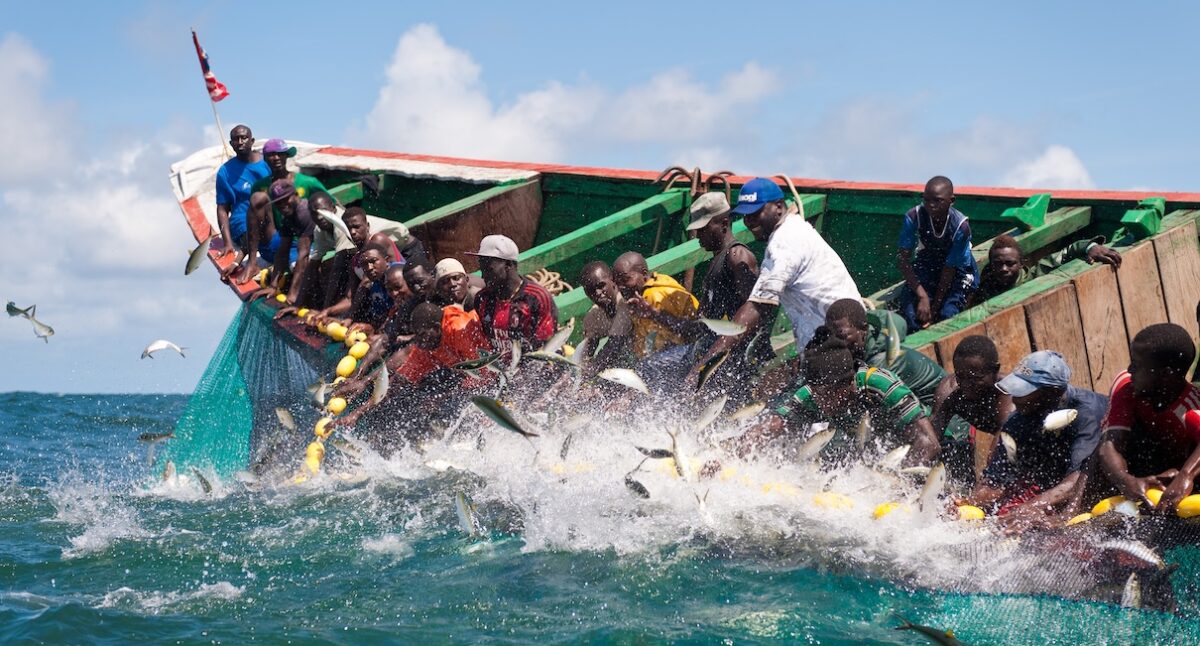
Much of the evidence came from reporting that went beyond government records and corporate reports. “The in-field reporting is really important to actually get on the ground,” Ryan told iMEdD. “You often hear about conditions or circumstances or some problem in person that you might not find in documentation, but once you know that it exists, that can help you actually find more evidence or more supporting material elsewhere.”
Ryan stressed the importance of corroborating what reporters learn in the field with documents. Records can reveal the true scale of a problem and help establish whether an apparent isolated case is part of a wider pattern.
Collaboration and publication
Ryan laughed as she admitted that, had they known how much work the final stages would take, they would have brought in outside help from the start. Most of the reporting was done in-house by a 12-person team at The Outlaw Ocean Project. Each team member had a distinct role in the newsroom, but everyone pitched in on different parts of the investigation. Once the team had gathered its findings, it turned to additional reporters and other newsrooms to verify the evidence and fill any gaps.
The Outlaw Ocean Project puts a lot of thought into how each investigation is presented to readers, and it was at this stage that the collaboration widened further. Alongside the tool developed for the project, the platform features stories by the project’s own journalists and outside contributors. The stories cover 20 countries where illegal activity documented during the investigation warranted a closer look.
For the two Outlaw Ocean Project journalists, what stayed with them was the significance of the story itself. “For me, the most surprising thing we found overall was that one fifth of the marine life that’s pulled out of the sea at the moment is going into feed. So it’s just being turned into food to feed something else,” Ryan said. “It wasn’t my specific finding. It came out of the wider investigation. I found that really astonishing.”
“To what degree do we think about what we eat eats?” Brush asked. “It’s no longer just about thinking about the seafood or the type of food that’s on your plate. You also have to take into consideration all of the inputs that go into it.”
Find Ian Urbina’s article about the platform Bait to Plate here. Find the methodology of the project here.